When overseas manufacturers prepare a shipment for Singapore, most attention goes to production quality. But there is another factor that decides installation success: can the Singapore team clearly understand what every package is, where it belongs and how it should be assembled?
A beautifully made wardrobe still creates delays if its eight cartons arrive without room references. A custom reception counter is hard to assemble without an exploded drawing. A hotel shipment can contain every component yet become chaotic if hardware for 50 rooms is packed in one unidentified carton. For imported FF&E, good packing is not only about protection during shipping — it is about preparing the furniture for efficient installation after arrival. At Rongda Pacific Pte Ltd, we work at the Singapore end where factory production, logistics and site conditions finally meet.
Shipping-Ready Is Not the Same as Installation-Ready
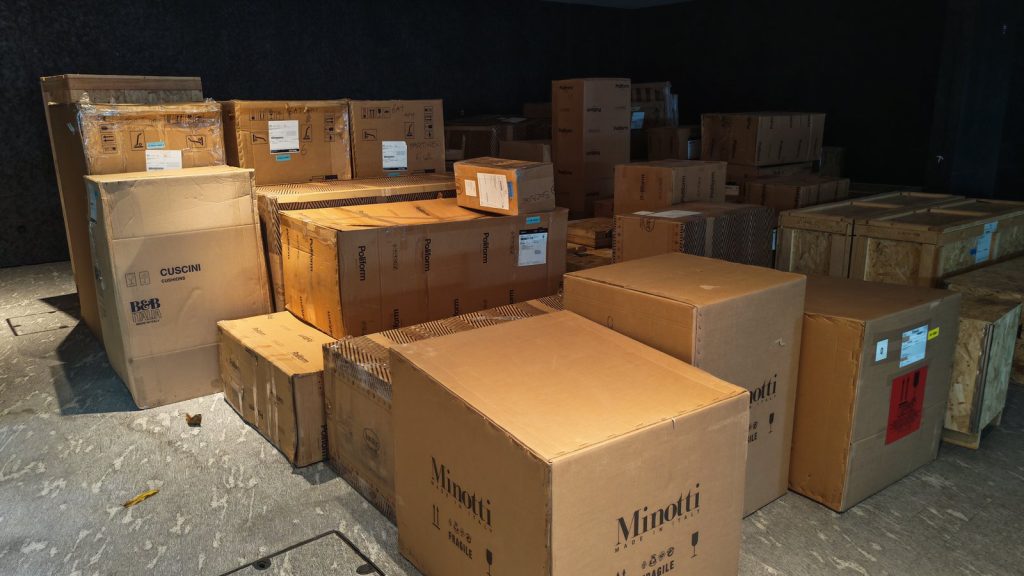
A shipping-focused system may simply label “Carton 001, 002, 003.” That helps with counting. But when hundreds of cartons reach a project, a more useful label identifies the project, tower, floor, room, furniture reference and package sequence — for example, “Level 08, Room 0812, Wardrobe W02, Package 2 of 6.” Now the warehouse, delivery team and installer immediately understand the package. That is the difference between merely shipping-ready and truly installation-ready.
A good furniture label speaks the language of the site — useful fields include:
- Project name
- Building / tower
- Floor
- Unit or room number
- Furniture description
- Furniture drawing reference
- Package sequence (e.g. 3/7)
- Manufacturer reference
Package Sequence and the Hardware Box
A wardrobe made of seven packages should clearly indicate 1/7, 2/7 … 7/7, so the receiving team can spot an incomplete set before it leaves the warehouse. And one of the most common causes of installation delay is not a missing large panel but a missing small hardware carton. Hinges, cam locks, 3-in-1 connectors, runners, brackets and handles packed into one generic “ACCESSORIES” box force the team to sort hundreds of parts before work can begin. Packing hardware by room and furniture item — “Unit 12-05, Master Bedroom Wardrobe MW-01, Hardware Kit” — saves substantial time on repetitive projects.
Assembly Drawings Are as Important as Furniture Drawings
A design drawing shows what the finished furniture looks like; an installation drawing explains how to build it. For complicated furniture, useful documentation includes exploded assembly drawings, panel identification, connection details, hardware locations, installation sequence, fixing locations, finished dimensions and levelling requirements. An exploded diagram lets the same references (Panel P01 → Left Side, P02 → Right Side …) appear on factory drawings, package labels and component stickers — a direct link between the drawing and the physical furniture.
Component Stickers, Left/Right and Mirrored Rooms
Once a carton is opened, installers may face several similar-looking panels — especially in repeated hotel rooms. Small removable component stickers (e.g. 0812-W02-P04 = Room 0812, Wardrobe W02, Panel P04) let the installer match each part to the drawing. Mirrored layouts are another common error source: furniture may look identical but have different drilling or orientation, so manufacturers should clearly identify “TYPE A — LEFT” and “TYPE A — RIGHT” rather than relying on subtle factory codes.
Documentation, Revision Control and Better Rectification
Technical documents should be organised digitally by project — furniture schedule, shop drawings, assembly drawings, packing list, hardware schedule, stone drawings, installation instructions and revision records — rather than scattered across messages. Every drawing should show its drawing number, revision, date and furniture reference, because a major risk in international projects is working from an outdated drawing. Clear references also improve rectification: instead of “one wardrobe panel is damaged,” the site reports “Unit 15-03 — MW-01 — Panel P04 damaged,” so the factory knows exactly which project, room, item and component to reproduce.
Frequently Asked Questions
What information should be printed on imported furniture cartons?
For project-based furniture: project name, building/tower, floor, room or unit, furniture reference and package sequence.
Should every panel have its own label?
For complex or repetitive projects, component-level identification makes assembly faster and reduces mixing similar panels.
Why are exploded assembly drawings important?
They show installers how components connect and significantly reduce time spent interpreting complex furniture on site.
How should furniture hardware be packed?
Where practical, grouped by the specific room and furniture item rather than combining accessories for many units into one generic carton.
Can you help if the furniture has already arrived with poor labelling?
Depending on the documentation available, cartons and components can be inspected, identified and reorganised before staged delivery and installation.