A grade means nothing without its test method. The same board produces three different numbers depending on how it was measured, which is how misleading claims survive.
Related service: custom carpentry and joinery in Singapore.
We compare E0 and E1 plywood for clients in Singapore by reading the referenced standard, the test method, the report itself and the application the board is going into.
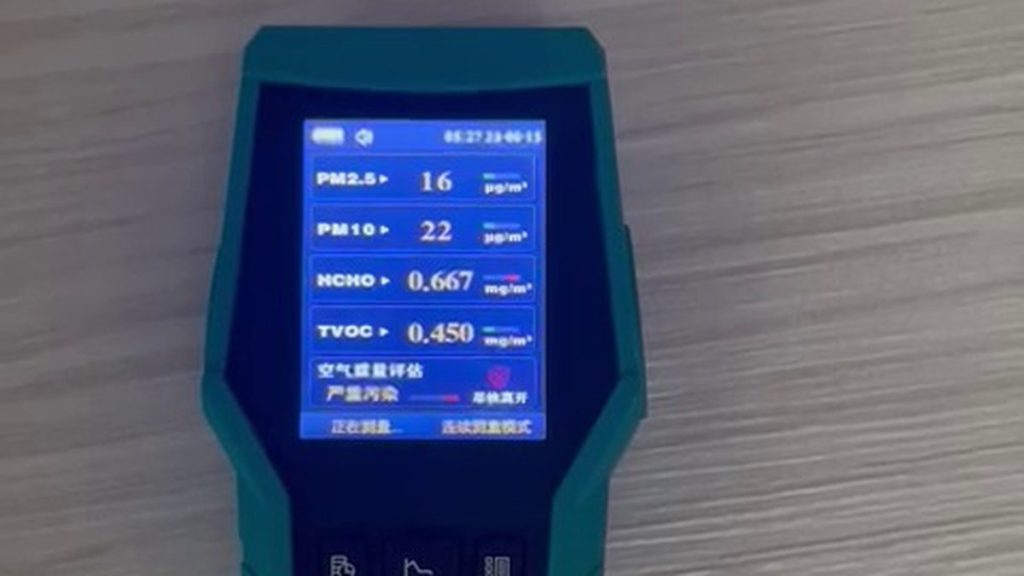
E0 permits about 40% of the chamber emission allowed under E1: 0.050 mg/m³ against 0.124 mg/m³ in a 1 m³ chamber. That is the simple comparison. The detail matters when you compare quotations, because a supplier quoting 0.3 mg/L is not describing the same measurement as one quoting 0.05 mg/m³.
Three Methods You Will Meet
| Method | What it does | Units | Notes |
|---|---|---|---|
| Climate chamber | Conditions the board in a controlled chamber and measures formaldehyde in the air | mg/m³ or ppm | The reference method behind E1, E0 and ENF. Closest to real exposure, slow and expensive |
| Desiccator | Absorbs emitted formaldehyde into water over 24 hours | mg/L | Basis of the Japanese F-star grades. Quick and cheap, a proxy for chamber results |
| Perforator | Extracts formaldehyde chemically from the board material | mg/100g | Measures content, not air emission. Good for factory quality control, poor as a guide to exposure |
The distinction that trips people up is content against emission. The perforator tells you how much formaldehyde is in the board. The chamber tells you how much reaches the air. They correlate, but not perfectly, because surface treatment, board density and moisture content all shift the relationship. When the specification is about indoor air quality, chamber data is the evidence that answers the question.
Why Old and New E1 Claims Differ
Chinese panel standards were reorganised over the past decade. Older grading used the desiccator method with E1 and E2 tiers. GB 18580-2017 then made a single chamber-based E1 limit of 0.124 mg/m³ mandatory, and GB/T 39600-2021 added the stricter E0 and ENF grades below it on the same basis.
So an old report in mg/L is not directly comparable with a current one in mg/m³, and a certificate a few years old may reference a standard that has since been superseded. Ask for the current standard and a current report.
Is E0 Worth the Difference?
The premium over E1 varies with board type, thickness, face specification, certification and availability. Where the increase is manageable, E0 makes a practical default for occupied interiors, because its chamber limit is materially lower: roughly 60% below E1. It counts for most where the board area is large against the room volume, such as a small bedroom with a full-height wardrobe wall, a study lined in panelling, or a compact office with joinery on three walls. It counts for least in a well-ventilated space with a handful of shelves.
Where the extra grade earns its money
- High board-to-volume ratio. Full-height joinery in small rooms.
- Low ventilation. Sealed air-conditioned rooms with few air changes.
- Long occupancy. Bedrooms and studies, where people spend eight hours with the door shut.
- Warm, humid conditions. Unconditioned spaces where heat and humidity drive emission up.
- Sensitive occupants. Children, elderly residents, asthma and allergy sufferers.
Reading a Test Report
A report that means something has six things in it. If any are missing, the document is decoration rather than evidence.
- The laboratory, named, with its accreditation stated.
- The standard and method, for example GB/T 39600-2021 by 1 m³ chamber, not merely “tested to E0”.
- The measured value, an actual number with units rather than the word “pass”.
- The product identity: manufacturer, product name, thickness and construction, so it can be matched against a delivery.
- The date, recent enough to reflect current production.
- The sampling basis: how the sample was taken, and by whom.
The usual weak point is not forgery. It is mismatch: a genuine report for a product that is not the one being delivered. That is why the check happens at delivery against the labels on the actual boards, and not only at tender stage.
Frequently Asked Questions
Can I convert a desiccator result to a chamber result?
Roughly. Published correlations exist and are useful as a sanity check, but they are not exact and they depend on product type. If your specification calls for a chamber-based grade, insist on chamber data.
Is E2 plywood still sold?
E2 was the higher-emission tier under older grading and does not meet current mandatory limits in the markets that adopted the newer standards. Seeing an E2 claim today is a strong signal that the documentation is out of date, and reason to look harder at the whole supply chain.
Does thickness affect emission?
Thickness and construction can affect the result, but the relationship is not a simple linear one. Glue-line count, board density, exposed edge area, surface treatment, moisture content and the test loading factor all matter. Test reports are product- and thickness-specific for that reason, so match the report to what you are buying.
Should I test boards on arrival?
For most fit-outs, documentation plus a delivery-label check is proportionate. On large or sensitive projects, or where a green rating depends on it, independent sample testing is worth the cost and belongs in the contract rather than being raised after delivery.
The information in this article is general project guidance. Final material grades, fabrication methods, tolerances and acceptance criteria should be confirmed against the project specification, approved drawings, applicable standards and actual site conditions. ENF, E0 and E1 classifications depend on the referenced standard and test method. They are not universal statutory grades for composite wood products in Singapore and should not be compared by grade name or numerical value alone.