
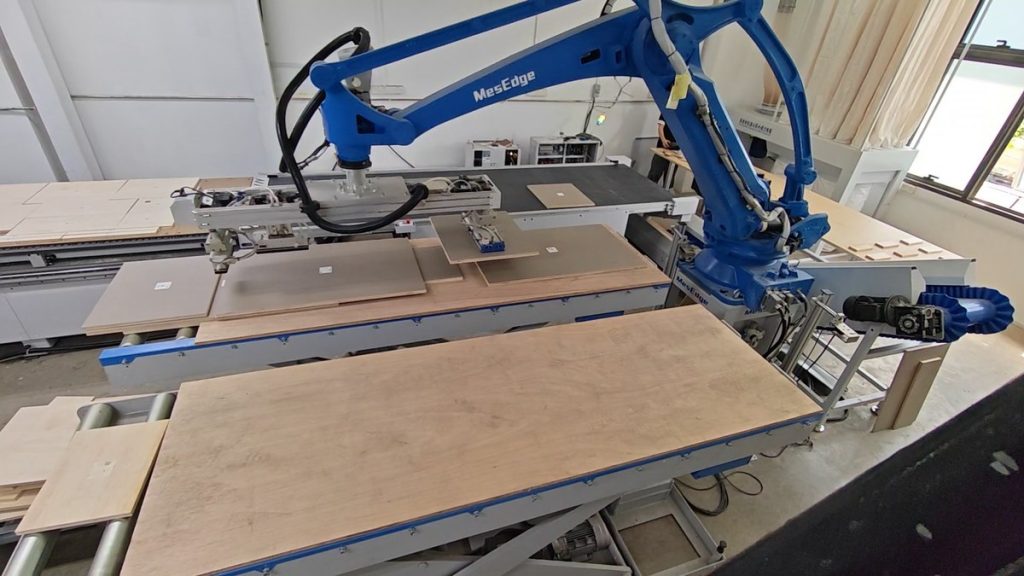
E1, E0 and ENF are emission grades. They cap how much formaldehyde a board releases into the air. They say nothing about strength, moisture resistance or how well the board is made.
Related service: custom carpentry and joinery in Singapore.
Quick answer: ENF vs E0 vs E1
- ENF ≤ 0.025 mg/m³: the strictest grade. Bedrooms, nurseries, healthcare and green-rated projects.
- E0 ≤ 0.050 mg/m³: the low-formaldehyde grade. Homes, offices, schools and large areas of exposed board.
- E1 ≤ 0.124 mg/m³: the long-standing baseline for general interior use.
All three are chamber-method emission limits in China’s GB/T 39600-2021. A lower number means less formaldehyde released into the air. None of them says anything about strength, moisture resistance or core quality.
We supply ENF, E0 and E1 board in Singapore with its test documentation, and fabricate and install the joinery ourselves.
Every plywood quotation now seems to carry a letter grade. E1 is the long-standing baseline, E0 is the low-formaldehyde grade, and ENF is the newest and strictest. They are useful and they are testable, which is more than can be said for most green claims. But they only help if you know what they measure.
Why There Is Formaldehyde in Plywood at All
Plywood is thin veneers bonded under heat and pressure. The bonding is done with adhesive, and for decades the cheapest effective adhesives have been formaldehyde-based resins, chiefly urea-formaldehyde and its melamine-modified and phenolic variants. They are strong, they cure fast and they cost very little. The trade-off is that the cured resin keeps releasing free formaldehyde as a gas for years, faster when the air is warm and humid.
Formaldehyde is a colourless gas with a sharp smell. It irritates eyes, nose and throat at low concentrations, and the International Agency for Research on Cancer classifies it as a Group 1 human carcinogen. That is why the limits exist, why they have tightened repeatedly, and why so much work has gone into no-added-formaldehyde adhesive chemistry.
ENF vs E0 vs E1 at a Glance
The E1 / E0 / ENF scale in current use comes from the Chinese national standard GB/T 39600-2021, which put all three grades on a single test basis: the 1 m³ climate chamber. That shared basis is what makes them comparable with each other, which earlier standards using different methods did not allow.
| Grade | Limit | Adhesive commonly used | Where it belongs |
|---|---|---|---|
| E1 | ≤ 0.124 mg/m³ | Urea-formaldehyde | General interior use; commonly treated as a baseline class under schemes that recognise it |
| E0 | ≤ 0.050 mg/m³ | Melamine-urea-formaldehyde | Homes, offices, schools, large areas of exposed board |
| ENF | ≤ 0.025 mg/m³ | Commonly MDI, soy or other low-emission systems | Bedrooms, nurseries, healthcare, sensitive occupants, green-rated projects |
What we supply
- We supply ENF, E0 and E1 board, with the test documentation for the product actually delivered.
- Where a specification calls for ENF, we confirm the board and its lead time with the manufacturer at tender stage rather than after award, and we will help you check whether E0 already meets the project requirement.
ENF is not a claim of zero. No wood product emits literally nothing, because timber releases trace formaldehyde on its own. ENF sets a very low chamber limit that approaches the lower range reported for some untreated wood products. Untreated timber is not necessarily emission-free, and results vary with species, moisture content and test conditions.
How These Compare Internationally
Singapore specifications borrow from several regimes, and consultants often mix them in one document.
- European E1 (EN 13986, tested to EN 717-1) uses a nominal chamber limit of 0.124 mg/m³ in the cited classification. The figure is the same, but compliance under one standard should not be presented as automatic compliance under the other: sampling, test procedure, conformity assessment and product scope all differ.
- Japanese F★★★★ (JAS/JIS, desiccator method) is a low-emission grade roughly comparable in ambition to E0.
- US CARB Phase 2 and EPA TSCA Title VI cap hardwood plywood at 0.05 ppm by a chamber method, with separate limits for particleboard and MDF, and exemptions for boards made with no-added-formaldehyde resins.
Test methods and units differ, so cross-standard conversions are approximate. If a specification demands a particular scheme, ask for a test report to that scheme’s own method rather than a supplier’s assurance that its grade is equivalent. The methods themselves are explained further down this page.
E0 vs E1: What the Test Numbers Actually Mean
E0 permits about 40% of the chamber emission allowed under E1: 0.050 mg/m³ against 0.124 mg/m³. That is the simple comparison. The detail matters when you compare quotations, because a supplier quoting 0.3 mg/L is not describing the same measurement as one quoting 0.05 mg/m³. Three test methods turn up in supplier documents:
| Method | What it does | Units | Notes |
|---|---|---|---|
| Climate chamber | Conditions the board in a controlled chamber and measures formaldehyde in the air | mg/m³ or ppm | The reference method behind E1, E0 and ENF. Closest to real exposure, slow and expensive |
| Desiccator | Absorbs emitted formaldehyde into water over 24 hours | mg/L | Basis of the Japanese F-star grades. Quick and cheap, a proxy for chamber results |
| Perforator | Extracts formaldehyde chemically from the board material | mg/100g | Measures content, not air emission. Good for factory quality control, poor as a guide to exposure |
The distinction that trips people up is content against emission. The perforator tells you how much formaldehyde is in the board; the chamber tells you how much reaches the air. They correlate, but not perfectly, because surface treatment, board density and moisture content all shift the relationship. When the specification is about indoor air quality, chamber data is the evidence that answers the question. A handheld meter reads the room at that moment, which is not the same thing as the chamber test and cannot be compared with it directly.
Older Chinese grading used the desiccator method with E1 and E2 tiers. GB 18580-2017 then made a single chamber-based E1 limit of 0.124 mg/m³ mandatory, and GB/T 39600-2021 added E0 and ENF below it on the same basis. An old report in mg/L is therefore not directly comparable with a current one in mg/m³, and a certificate a few years old may reference a standard that has since been superseded. An E2 claim today is a strong sign the documentation is out of date.
A test report that means something names the laboratory and its accreditation, the standard and method (for example GB/T 39600-2021 by 1 m³ chamber, not merely “tested to E0”), the measured value with units, the product’s manufacturer, name, thickness and construction, the test date, and how the sample was taken. The usual weak point is not forgery but mismatch: a genuine report for a product that is not the one being delivered. That is why the check belongs at delivery, against the labels on the actual boards, and not only at tender.
Why It Matters More Here
Formaldehyde release goes up with temperature and relative humidity. A board that tests comfortably at 23°C and 45% RH in a laboratory will emit more in an unconditioned Singapore flat at 30°C and 80% RH.
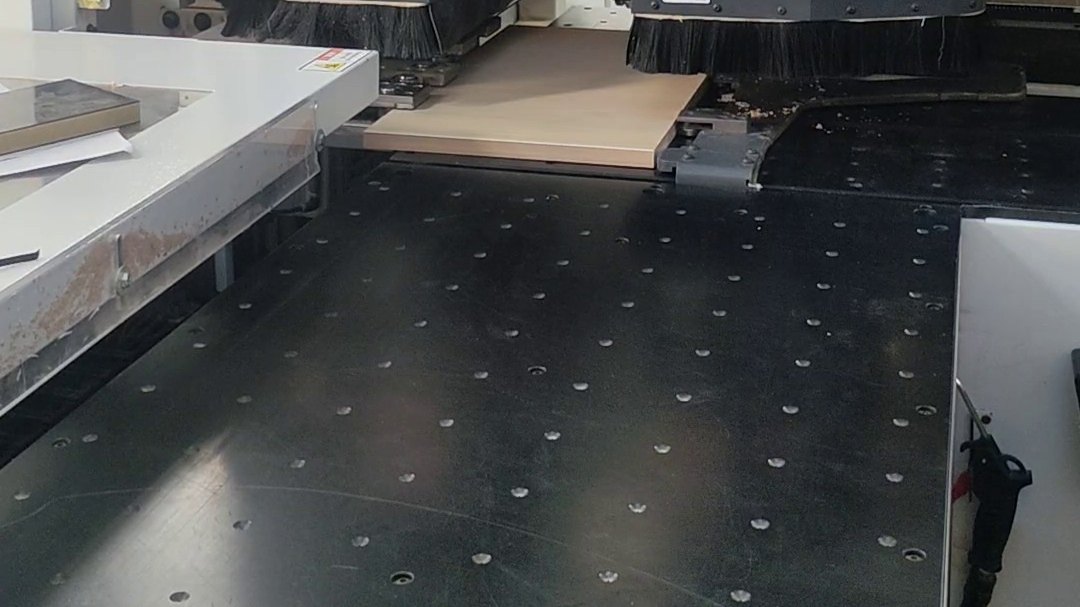
Then add the way we build here: tightly sealed air-conditioned rooms with modest fresh-air rates, and fit-outs that put several hundred square metres of board into a small apartment as carcasses, wardrobes, feature walls and ceiling boxing. The total loading matters as much as the grade printed on each panel.
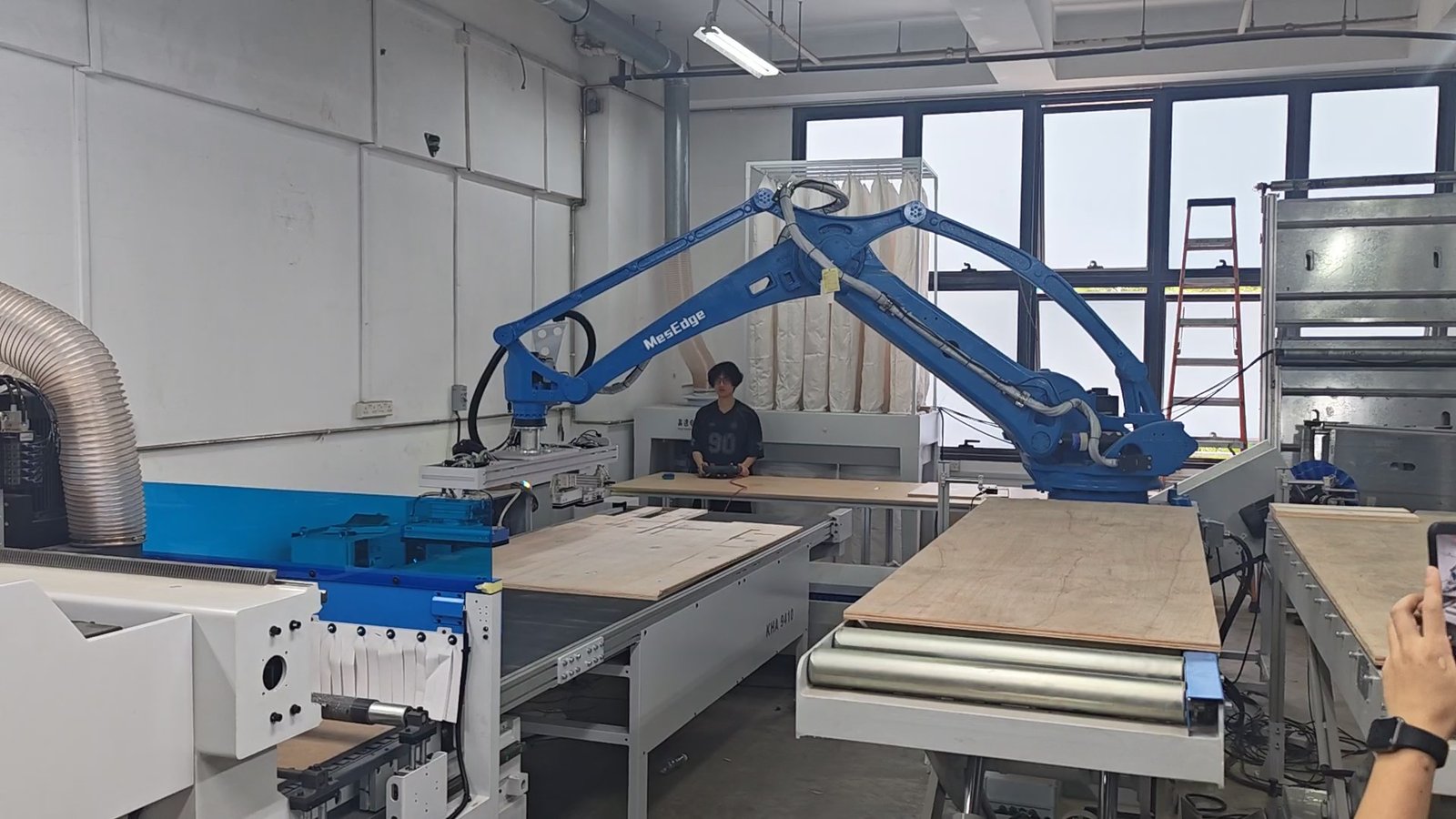
Four things set what people actually breathe
- Area. A full-height wardrobe wall contributes far more than a shelf. Emission scales with exposed surface.
- Grade. The emission rate per square metre that you specified.
- Ventilation. Sealed rooms with few air changes concentrate whatever is released.
- Time. Emission decays over months and years, so the first weeks after installation are the peak.
Choosing a Grade Without Overpaying
A single grade for the whole project is the simplest specification to write, but it is rarely the best use of the budget. Grading the requirement room by room usually gets more for the money:
- Bedrooms, nurseries, healthcare, childcare. E0 as the working minimum, particularly where the joinery area is large against the room volume. Where a specification calls for ENF, treat it as a procurement question and confirm supply early.
- Living areas, offices, schools. E0 for board-heavy rooms; E1 is defensible where the area is small and ventilation is good.
- Back-of-house and concealed carcass work. E1 may be accepted where the project specification permits it and the installed board area is limited, although E0 gives a lower-emission default for occupied interiors.
One thing gets forgotten regularly: emission grade says nothing about performance. An ENF board can still be poorly made, dimensionally unstable, or bonded with an adhesive that will not survive a wet area. Grade and construction quality are two separate specifications and both belong in the document. We take that up in choosing plywood for tropical joinery.
Frequently Asked Questions
What is ENF plywood?
ENF is the strictest formaldehyde-emission grade in China’s GB/T 39600-2021 classification. It caps chamber emission at 0.025 mg/m³, half the E0 limit. ENF board is usually bonded with MDI, soy-based or other low-emission adhesives. Like E0 and E1, the grade describes emission only, not strength, moisture resistance or how well the board is made.
ENF or E0: which should I specify?
E0 is enough for most homes, offices and schools. ENF is worth specifying where large areas of board sit in small, closed rooms such as bedrooms, nurseries and clinics, or where a green-building rating asks for it. Expect ENF to cost more and to narrow the choice of suppliers, so decide before tender rather than after award.
Is ENF plywood completely formaldehyde-free?
No, and a supplier claiming zero is worth a second look. Wood emits trace formaldehyde by itself. ENF caps measured chamber emission at 0.025 mg/m³, a very low limit that approaches the lower range reported for some untreated wood products.
Does E1 mean the board is unsafe?
No. Under the standards and jurisdictions that recognise it, E1 commonly functions as a baseline interior-emission class. It should not be read as a universal Singapore statutory approval, or as a complete indoor-air-quality assessment. The case for E0 and ENF is cumulative exposure: large board areas, small sealed rooms, warm humid air and sensitive occupants.
Do emissions fall over time?
Yes. Release is highest when the board is new and decays over months and years. Ventilating a newly finished fit-out hard for the first few weeks makes a measurable difference, though it is no substitute for specifying the right grade.
Does laminating or edge-banding help?
It does. A sealed face and properly banded edges slow release from the board underneath, and exposed raw edges are a disproportionate source. Useful as a supplement to a good grade, not as a replacement for one.
Can I tell the grade by smell?
Not reliably. A sharp smell in a new room suggests high emission, but low-emission boards can also smell of adhesives and coatings, and a board that smells fine can still be E1 or worse. A current test report tied to the product you are buying is the only dependable evidence.
The information in this article is general project guidance. Final material grades, fabrication methods, tolerances and acceptance criteria should be confirmed against the project specification, approved drawings, applicable standards and actual site conditions. ENF, E0 and E1 classifications depend on the referenced standard and test method. They are not universal statutory grades for composite wood products in Singapore and should not be compared by grade name or numerical value alone.
More in Custom Carpentry & Joinery
 How to Maintain Spray-Painted Furniture in Singapore: Cleaning, Wear Zones and What Belongs in the Handover Record
 Integrated Appliances & Imported Cabinetry in Singapore: Why Fridges, Ovens and Dishwashers Need Early FF&E Coordination
 Local Spray-Paint Rectification for Imported Furniture in Singapore: Repairing DLP Defects Without Shipping Panels Overseas