
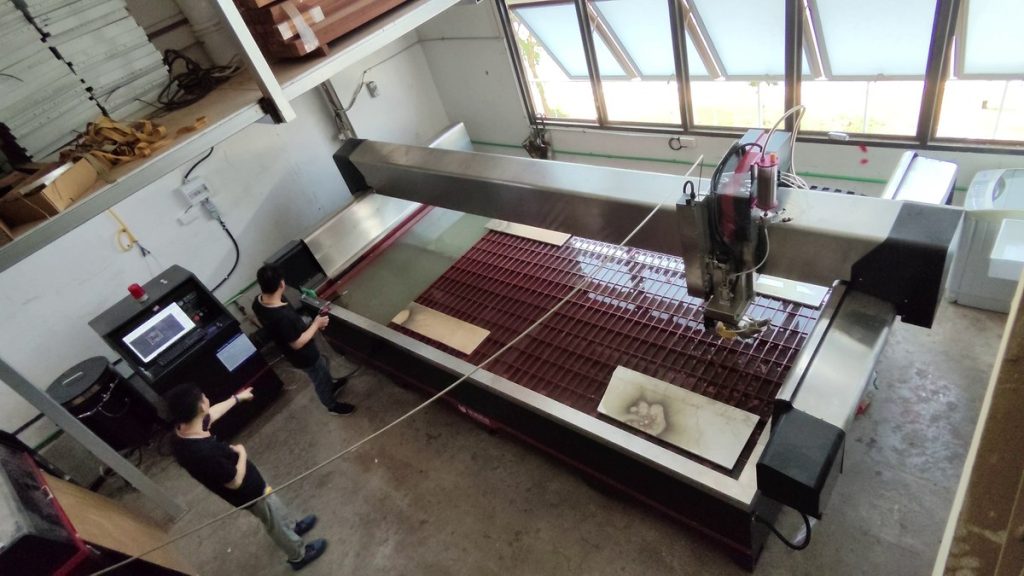
No single process cuts everything best. The right choice depends on the plate, the tolerance and what happens to the part after cutting, not on the machine a supplier owns.
Related service: metal fabrication in Singapore.
Abrasive waterjet is our lead process for plate work in Singapore, with laser cutting for thin sheet and fibre laser welding to join the parts afterwards. This comparison looks at the complete fabrication chain, not at a single machine.
The right cutting process depends on four factors: the thickness of the plate, the alloy, how tight the tolerance and edge condition need to be, and what happens to the part after cutting. This article compares waterjet, fibre laser and plasma against those four factors, so you can specify the right process and check a quotation against it.
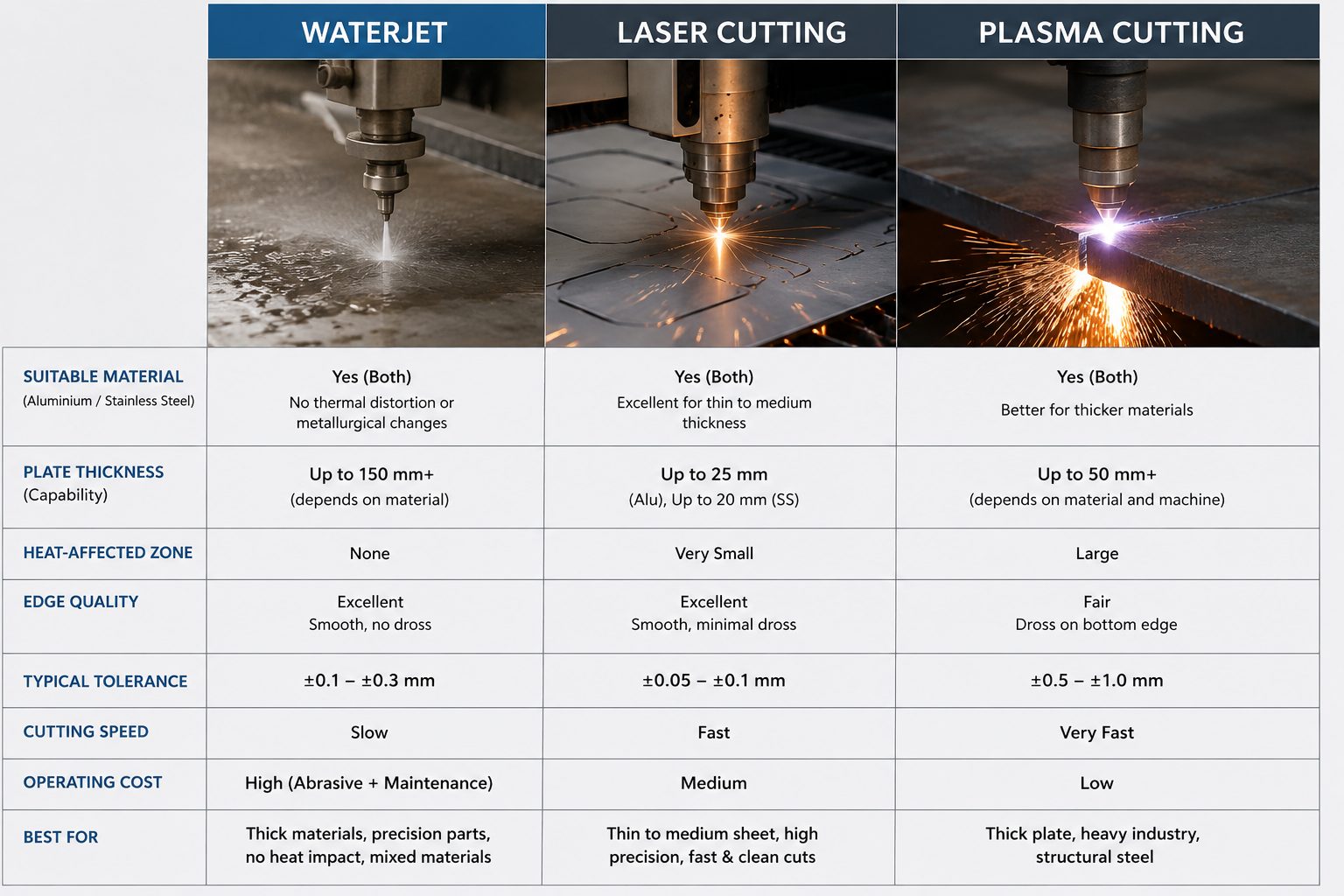
The Three at a Glance
| Abrasive waterjet | Fibre laser | Plasma | |
|---|---|---|---|
| How it cuts | Cold erosion by garnet-loaded water | Melting and vaporising by focused beam | Melting by ionised gas arc |
| Heat-affected zone | None. Cold process | About 0.05–0.3 mm | About 0.5–2.0 mm |
| Typical range on our project work | 6 mm to 100 mm+ | 0.5 mm to about 20 mm | 5 mm to 50 mm |
| Edge condition | Square, matt, scale-free | Clean; dross appears as thickness rises | Bevelled, oxidised, hardened |
| Typical tolerance | ±0.1–0.3 mm | ±0.05–0.15 mm | ±0.5–1.5 mm conventional; high-definition plasma is tighter |
| Kerf width | 0.8–1.5 mm | 0.1–0.3 mm | 1.5–4.0 mm |
| Cut speed, 10 mm steel | 0.15–0.30 m/min | 2.0–3.0 m/min | 2.5–4.0 m/min |
| Materials | Metal, stone, glass, composite | Metal only | Conductive metal only |
Two rows there are easy to overlook. Kerf width decides how tightly parts can be nested, so a 4 mm plasma kerf consumes plate that a 0.2 mm laser kerf keeps, and on a large order that shows up directly in the sheet count. Cut speed is quoted for 10 mm steel because that is the thickness at which the three processes are most directly comparable; the ranking shifts as plate gets thinner or heavier, and the figures move with machine power and assist gas.
Fibre Laser: The Default for Thin Sheet
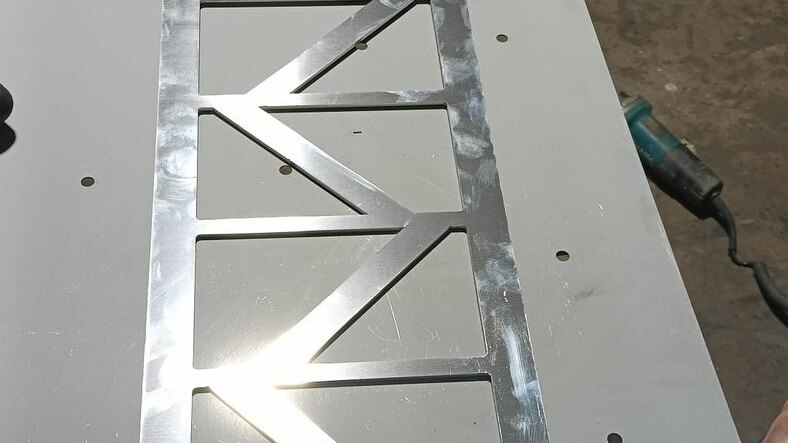
For sheet up to a few millimetres a fibre laser is hard to beat. It is fast, its kerf is narrow enough to nest parts tightly, and it holds small features well. Most decorative screens, perforated panels, signage backers and enclosure bodies sit in that band, and we cut them on the laser rather than the waterjet.
Two things change the picture. Thickness is the obvious one: as plate gets heavier the cut slows sharply, dross on the underside becomes harder to avoid, and the cost advantage disappears. The other is aluminium. It is reflective and highly conductive, and although modern fibre lasers handle it far better than the CO2 machines of ten years ago, thick aluminium is still a demanding cut with a real risk of dross. Above about 10 mm to 12 mm in aluminium, waterjet is usually the better engineering call.
Waterjet: When Heat Is the Problem
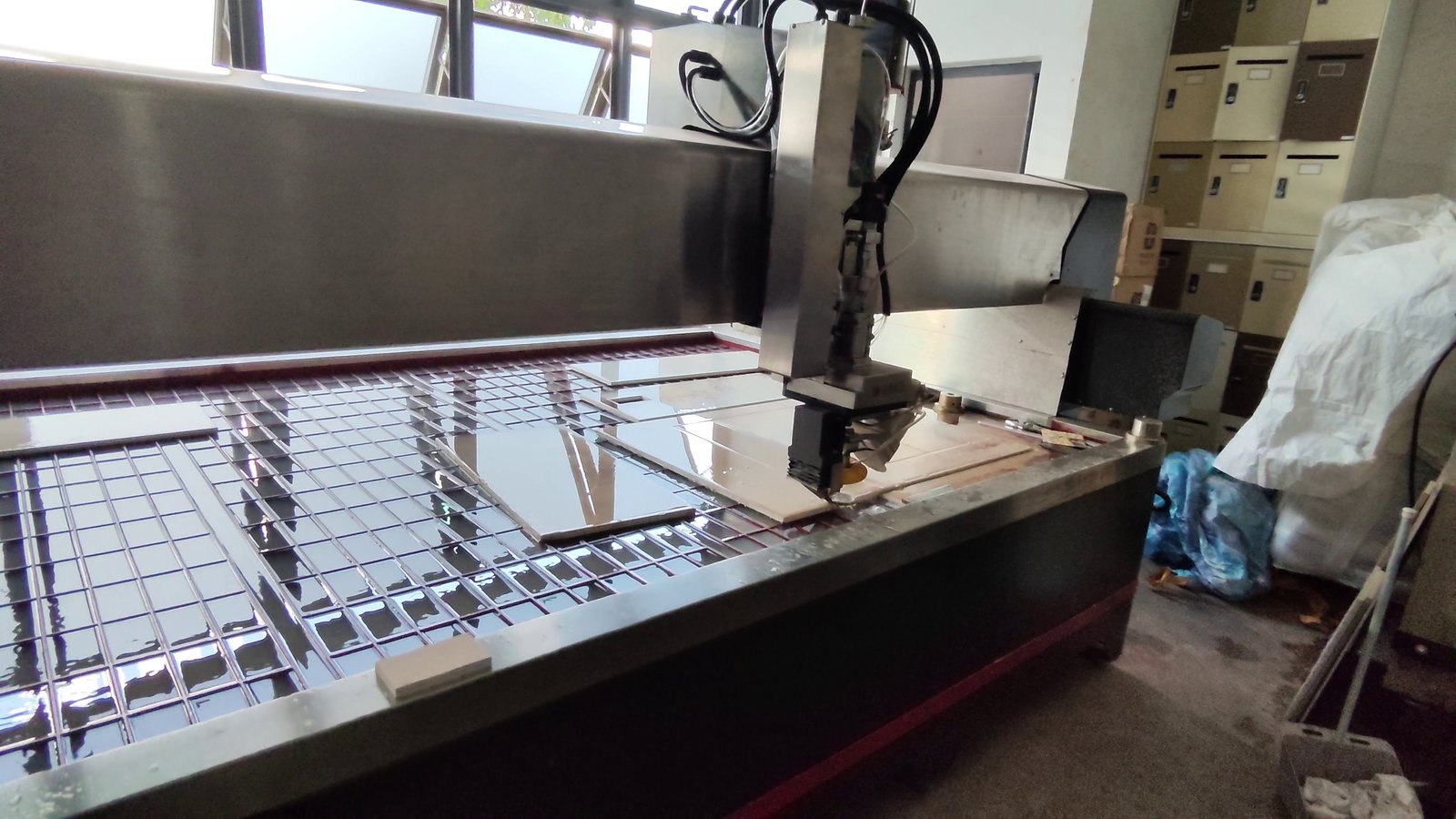
Any one of these usually settles the choice on its own:
- The plate is thick. Aluminium above roughly 10 to 12 mm, stainless above roughly 15 mm, depending on the machine and the edge required.
- The material condition has to survive. Heat-treated aluminium alloys, marine 316, food-contact surfaces, or anything where a heat-affected edge is a specification failure.
- Flatness matters. Long profiles, large panels, or parts with extensive internal cut-outs that would distort under thermal stress.
- The part will be laser welded. Laser welding needs tight fit-up, and a square, scale-free edge can substantially reduce the secondary preparation required.
- The material is not metal. Stone, porcelain, glass, composite panel and acrylic all cut on the same table from the same geometry.
Plasma: Fast and Cheap, Within Its Limits
Plasma cuts with an ionised gas arc running at roughly 20,000 to 30,000 °C, which is why it is fast and why the heat-affected zone is wide. It is quick and inexpensive on medium-to-thick conductive plate, and it has an obvious place on structural steelwork where the edge is going to be ground, welded and painted anyway. What it cannot give you is a finish-quality edge. The arc leaves a bevel, an oxidised surface and a hardened band that resists drilling and tapping and interferes with weld quality. On stainless it also degrades corrosion resistance at the edge. It remains suitable for concealed structural members where the edge will be dressed and coated, but is generally a poor choice for exposed architectural work or precision-welded assemblies.
Two Worked Examples
2 mm stainless decorative screen, 60 panels
Fibre laser, without hesitation. The material is thin, each panel has hundreds of internal profiles, and the total cut length is enormous. Those are exactly the conditions where laser speed dominates. A waterjet could produce the part just as well, but typically at a substantially higher cutting cost and a longer lead time for this geometry and quantity.
25 mm aluminium machine base with a bolt pattern, four units
Waterjet. Thick aluminium, flatness matters, the hole positions have to be right, and the customer does not want a softened zone around the edge of a load-bearing part. At four units, machine speed matters little. What matters is dimensional accuracy.
Rule of thumb
- Under 3 mm, high quantity: laser.
- 3–10 mm with a quality edge required: laser or waterjet, decided by alloy and by what happens next.
- Over roughly 10–12 mm aluminium or 15 mm stainless on our typical work: waterjet.
- Hidden structural steel, thick, ground afterwards: plasma.
Ask a Fabricator, Not a Cutting Bureau
A cutting-only supplier will naturally optimise around the equipment it has available. A fabricator responsible for the downstream assembly has an additional incentive to weigh total rework and finishing, because that work lands on its own bench. When we quote we look at the whole chain: cut, form, weld, finish, install. Often that means telling you the part belongs on the laser rather than the waterjet, and quoting accordingly. The processes themselves are covered in more detail in our guides to waterjet cutting thick plate and laser welding.
Frequently Asked Questions
Which process is most accurate?
On thin material, fibre laser commonly holds the tightest tolerance. On thicker material, waterjet often has the advantage where heat distortion, dross and edge condition become the limiting factors. Plasma generally works to wider tolerances than either process.
Can one job use more than one process?
Most do. A single assembly might have laser-cut skins, a waterjet-cut base plate and saw-cut extrusions. Keeping all of it in one workshop is what stops dimensional drift creeping in between suppliers.
Does laser cutting ruin stainless steel’s corrosion resistance?
It alters the edge rather than ruining it. Laser cutting leaves a narrow heat-affected zone and may also leave an oxidised edge. Depending on the assist gas, the exposure and the project specification, that edge may require oxide removal and an appropriate corrosion-restoration treatment. Waterjet avoids the issue altogether, which is why marine work often specifies it.
What do you need to quote?
DXF, DWG or STEP is ideal, a dimensioned PDF or clear sketch is enough to start. Tell us alloy, thickness, quantity, tolerance and finish, and whether the parts get welded. That last point changes the recommendation more often than anything else.
The information in this article is general project guidance. Final material grades, fabrication methods, tolerances and acceptance criteria should be confirmed against the project specification, approved drawings, applicable standards and actual site conditions.
More in Metal Fabrication
 Integrated Glass, Aluminium & Metal Components in Imported Furniture: Why Luxury FF&E Needs Multi-Trade Installation Coordination in Singapore
 Waterjet Cutting for Thick Aluminium and Stainless Steel Plate in Singapore
 Laser Welding Stainless Steel and Aluminium: Low-Distortion Seams for Finish-Critical Work