
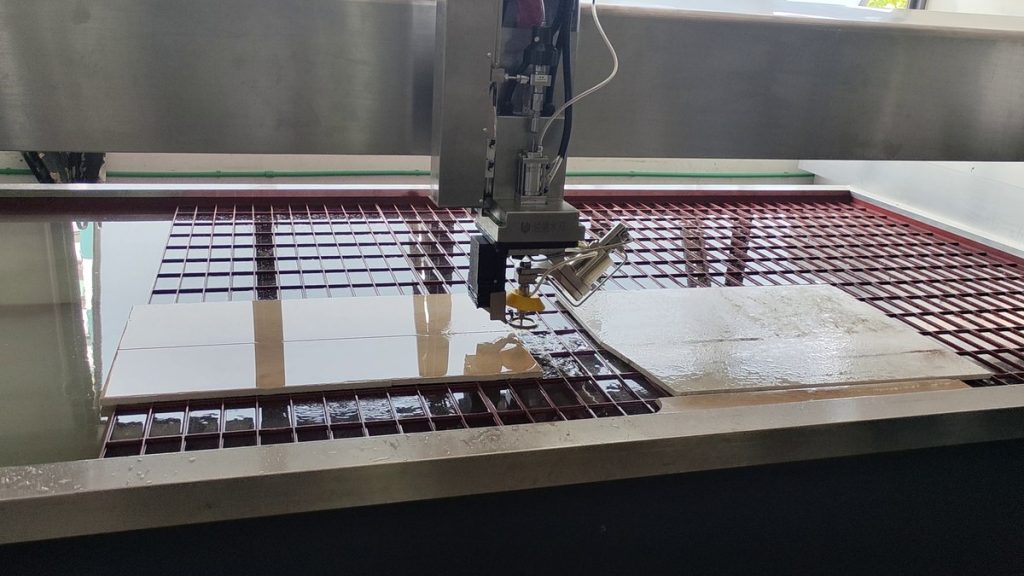
Waterjet cuts cold. Nothing burns and nothing melts, so thick aluminium and stainless steel come off the table without a thermally altered edge, and with substantially less distortion to correct before welding.
Related service: metal fabrication in Singapore.
Abrasive waterjet is the process we lead with for plate work in Singapore. We cut thick aluminium and stainless steel on it for commercial fit-out, architectural metalwork, equipment components and one-off project parts, then laser weld, finish and install the completed work. Laser cutting sits alongside it for thin sheet.
Thin sheet is easy to get cut in Singapore. Thick plate is harder.
On the mix of work we see, the practical crossover sits somewhere past roughly 10 to 12 mm in aluminium and around 15 mm in stainless, though machine power, alloy, geometry and the required edge condition all move it. As plate gets heavier, fibre lasers slow down and dross on the underside becomes harder to avoid, plasma leaves a bevelled edge that the arc has hardened, and a saw cuts straight lines and nothing else. When a drawing asks for profiled shapes in heavy plate, such as machine bases, structural gussets, counter frames, brackets or marine-grade stainless components, abrasive waterjet is usually the process we would put it on.
How It Works
A pump pushes water through an orifice about a quarter of a millimetre across. What comes out the other side is travelling several times the speed of sound. Garnet abrasive, usually 80 mesh, gets drawn into that stream inside a mixing tube, and the loaded jet erodes its way through the metal along a CNC path.
The machine reads the same CAD geometry a laser cutter reads. Internal cut-outs, tight external corners, bolt patterns, logos, nested shapes: if you can draw it, we can cut it.
One property explains most of what follows. Compared with thermal cutting, waterjet puts very little heat into the plate and does not create a conventional heat-affected zone.
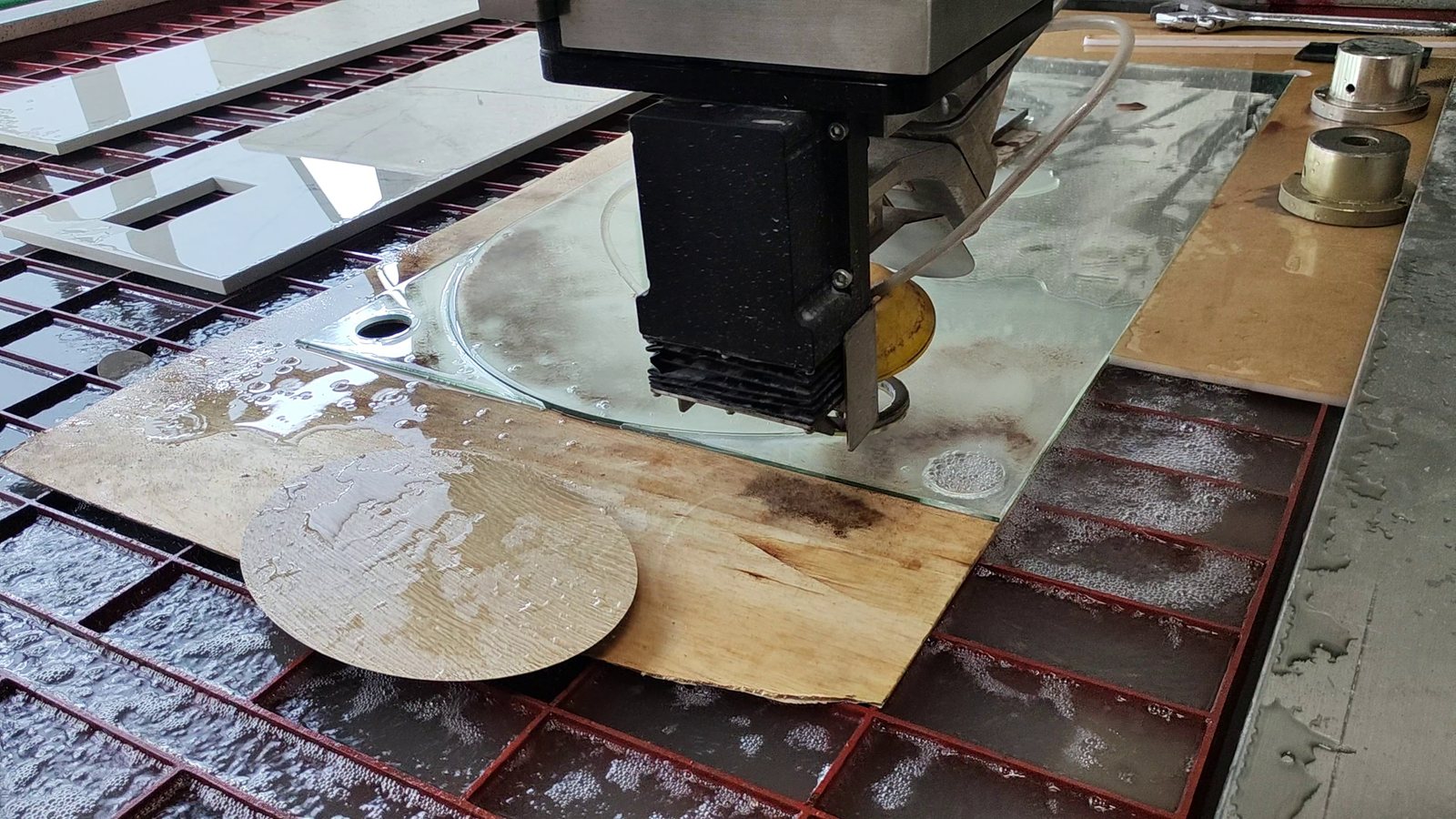
Why Thick Plate Belongs on a Waterjet
Thickness that thermal processes struggle with
Waterjet is routinely considered for aluminium at 20 mm, 50 mm and beyond, and for stainless steel at 25 mm and above, subject to the tolerance and edge quality required. Small parts can also be stacked several sheets deep and cut in one pass for production economy. That range of work is awkward or uneconomic on a laser.
Waterjet performance is also not constrained by reflectivity or electrical conductivity in the way laser cutting can be. Thick aluminium, copper and brass go through it without the trouble they give a laser.
No thermally altered cut edge
Laser, plasma and oxy-fuel all leave a band along the cut whose microstructure the heat has altered. On stainless, that band has lost part of its corrosion resistance at exactly the point where the edge is most exposed. On heat-treated aluminium it is soft. On mild steel it can be hard enough to blunt a drill or a tap.
Waterjet leaves the parent metal without a thermally altered cut edge. Where an engineer has specified a material condition for marine, food-contact or structural service, cold cutting preserves it at the edge.
Better retention of flatness
Thermal cutting puts heat into a plate unevenly, and the plate moves in response. On a long thin profile, or a panel with a lot of internal cut-out area, that movement is visible and it is permanent. Because waterjet adds no heat, a three-metre stainless steel fascia is far more likely to retain the flatness it had before cutting, although residual stress in the material, support and cut sequence can still cause some movement. For architectural metalwork where the finish is on show, this is often the deciding factor.
Edges that often need less preparation before welding
A waterjet edge is square, matt and free of dross and oxide scale. Weld quality depends heavily on how tightly the joint closes and how clean the edges are, so these parts often need substantially less work before fit-up and welding, subject to the cut quality specified, taper, deburring and any garnet residue. Plasma-cut parts normally need grinding first. That is the practical reason waterjet and laser welding get used together.
Not only metal
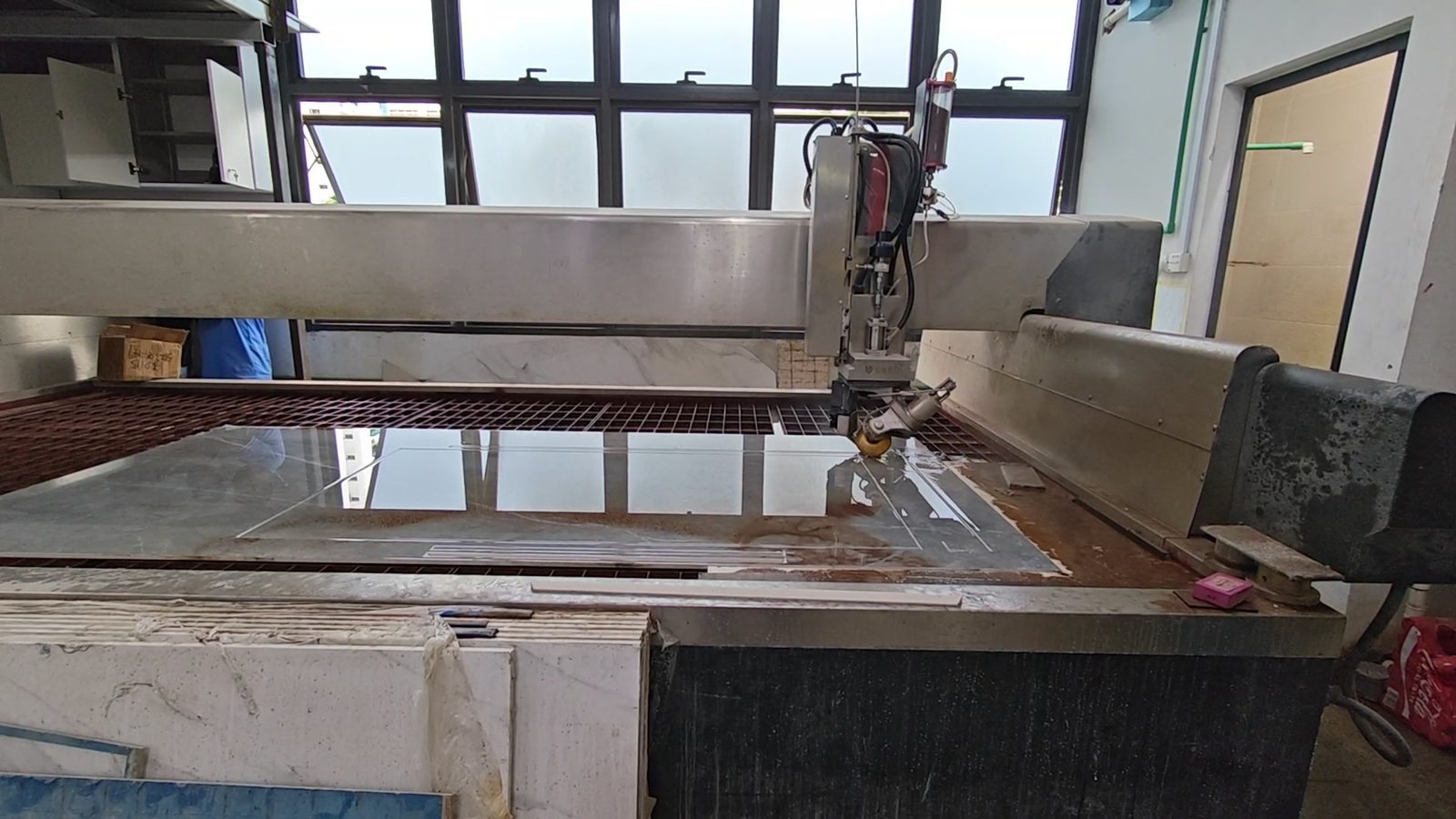
The same table cuts stone, ceramic tile, glass, composite panel, acrylic and rubber. On fit-out work that gets used more than you would expect: the same profile in stainless steel and in marble for an inlaid floor feature, or a logo cut through both an aluminium face plate and its acrylic backer so the two line up exactly.
Where Waterjet Is the Wrong Answer
No process suits every job, and a supplier who presents one as universally best is describing its own equipment rather than your problem.
Four honest limitations
- High-volume thin sheet. Below about 3 mm a fibre laser is several times faster and cheaper per part, and on comparable thin material waterjet can run five to ten times slower. Waterjet becomes the more economic choice as thickness increases.
- Kerf taper. The jet loses energy on the way down, so an uncompensated cut is slightly V-shaped, on the order of a degree.
- Very small internal features. A hole much smaller than the plate is thick is better drilled than pierced.
- Consumables. Garnet, orifices and mixing tubes are real running costs, which is why nesting efficiency shows up directly in your quotation.
What We Cut for Singapore Projects
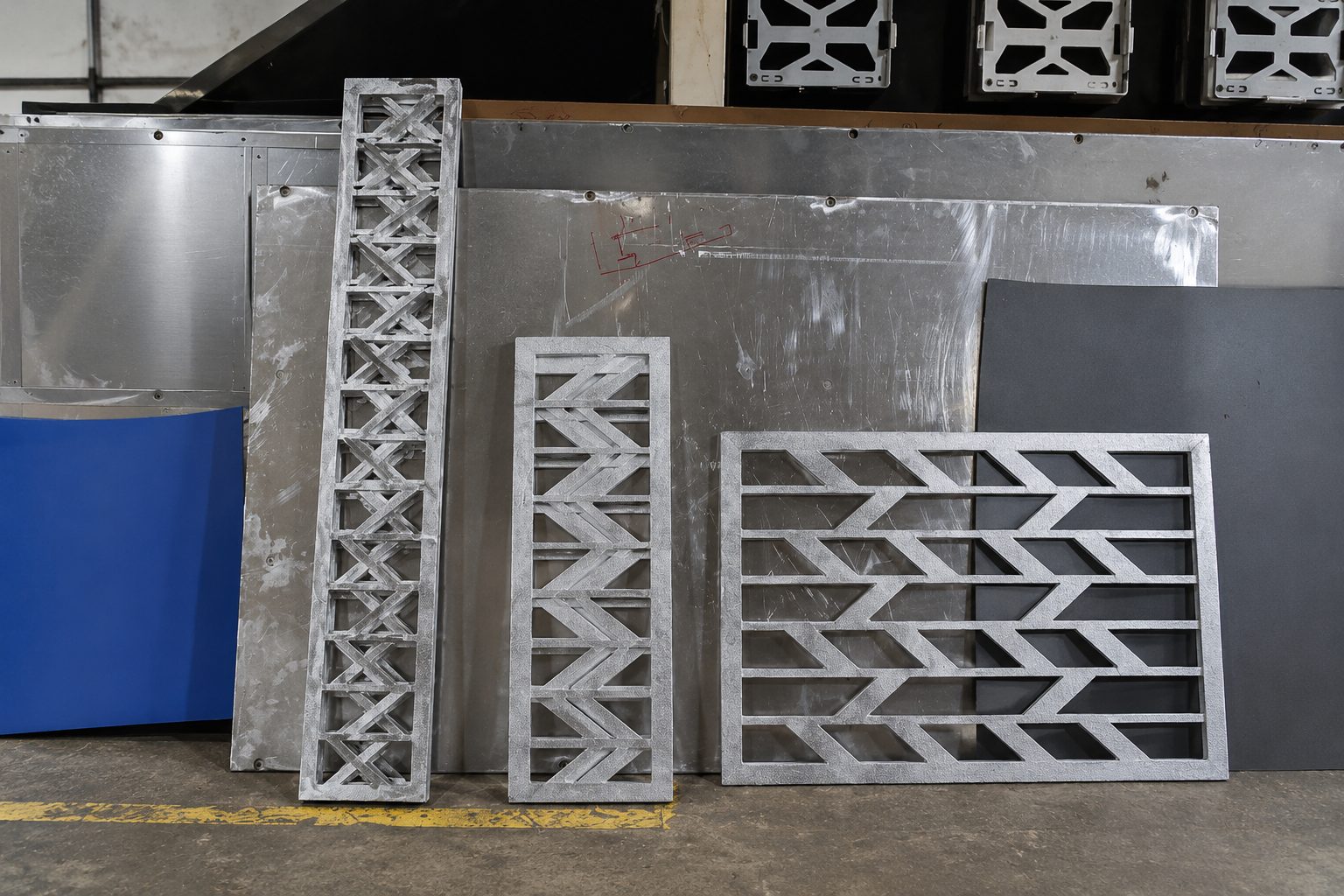
- Architectural metalwork. Thick decorative screens, feature panels, signage backers, reception counter frames, stair components.
- Structural and machine parts. Gussets, base plates, mounting brackets, spacers and flanges in mild steel, stainless and aluminium.
- Marine and coastal components. 316 stainless plate parts where edge corrosion resistance cannot be traded away.
- M&E and plant items. Tank plates, louvre frames, access covers, penetration plates, equipment enclosures.
- Stone and tile inlays. Profiled marble, granite and porcelain cut to match a metal surround.
Getting an Accurate Quotation
Four things drive the cutting price: material and thickness, total cut length including every internal profile, the number of pierces, and how well your parts nest on a standard plate.
Send a DXF, DWG or STEP file. A dimensioned sketch is enough to start if the design has not yet reached CAD. Tell us the alloy, thickness, quantity and finish, and we will come back with an itemised price and a lead time. If the part would be better and cheaper on the laser or the saw, we will say so.
Frequently Asked Questions
How thick can waterjet cut aluminium and stainless steel?
Well beyond what most fit-out and fabrication work needs. 100 mm and more is achievable, with cutting speed dropping as thickness rises. What matters is the edge quality and tolerance you need at that thickness, because both are settings you pay for in machine time.
Does waterjet cutting leave a burr?
Much less than mechanical or thermal cutting. There can be a light frosting on the exit side, more so on softer aluminium, and we take that off during deburring before the part goes to welding or finishing. It does not produce the fused dross or oxide scale a plasma cut leaves behind.
Will the water cause rust?
Not on stainless or aluminium. Parts are only briefly in contact with water and are dried after cutting. Mild steel should not be left wet, so we dry it and, where the job calls for it, oil or prime it before it leaves the workshop.
Can you cut a shape without a CAD file?
Yes. A dimensioned sketch, a photograph with a measured reference, or a physical template is enough for us to produce the cutting file. We send it back for your approval before any material is cut.
Is waterjet more expensive than laser cutting?
On thin sheet, usually. On thick plate the comparison turns around, and once you count the grinding, straightening and edge preparation a thermal cut needs before it can be welded, waterjet is often the cheaper route to a finished assembly.
The information in this article is general project guidance. Final material grades, fabrication methods, tolerances and acceptance criteria should be confirmed against the project specification, approved drawings, applicable standards and actual site conditions.
More in Metal Fabrication
 Integrated Glass, Aluminium & Metal Components in Imported Furniture: Why Luxury FF&E Needs Multi-Trade Installation Coordination in Singapore
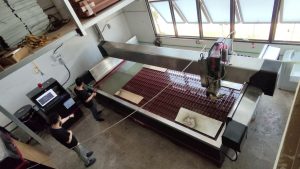 Waterjet, Laser or Plasma? Choosing a Cutting Process for Aluminium and Stainless Steel
 Laser Welding Stainless Steel and Aluminium: Low-Distortion Seams for Finish-Critical Work