
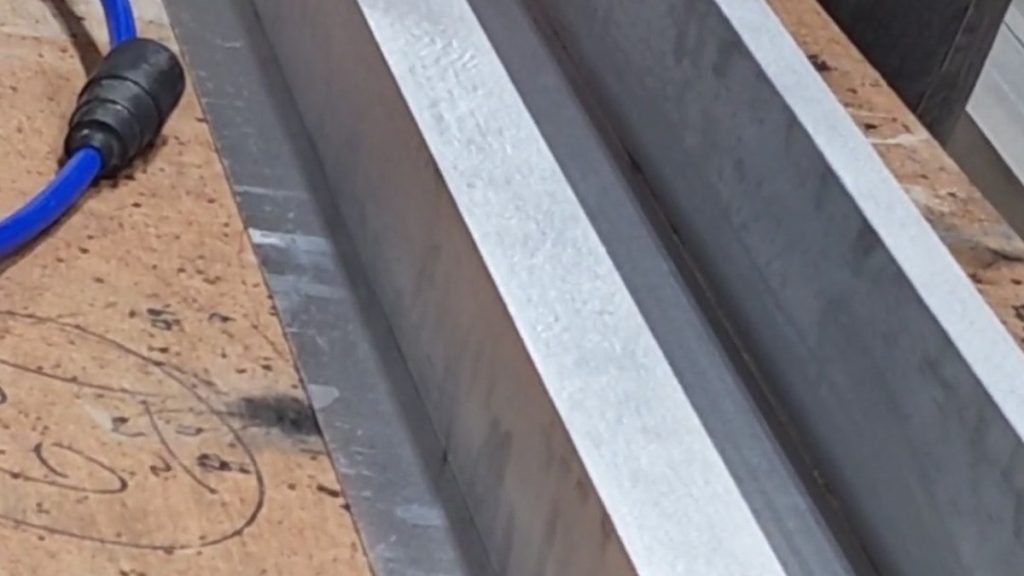
A fibre laser puts far less heat into a joint than TIG does. Flat parts are far more likely to stay flat, square assemblies to stay square, and on stainless steel a light polish is often all the seam needs.
Related service: metal fabrication in Singapore.
We laser weld stainless steel and aluminium assemblies in Singapore where seam appearance, dimensional control and reduced finishing matter. The parts that go into them are usually cut cold on our own waterjet, which gives the close, clean-edged fit-up that laser welding needs.
Cutting shapes the parts; welding turns them into a finished product. On finish-critical stainless steel and aluminium work such as reception counters, cladding, handrails, enclosures, planters and food-service equipment, the welding stage is where the quality is decided. High-heat processes put a large amount of energy into the joint, and the metal responds with distortion, discolouration and a wide bead that has to be ground back and refinished.
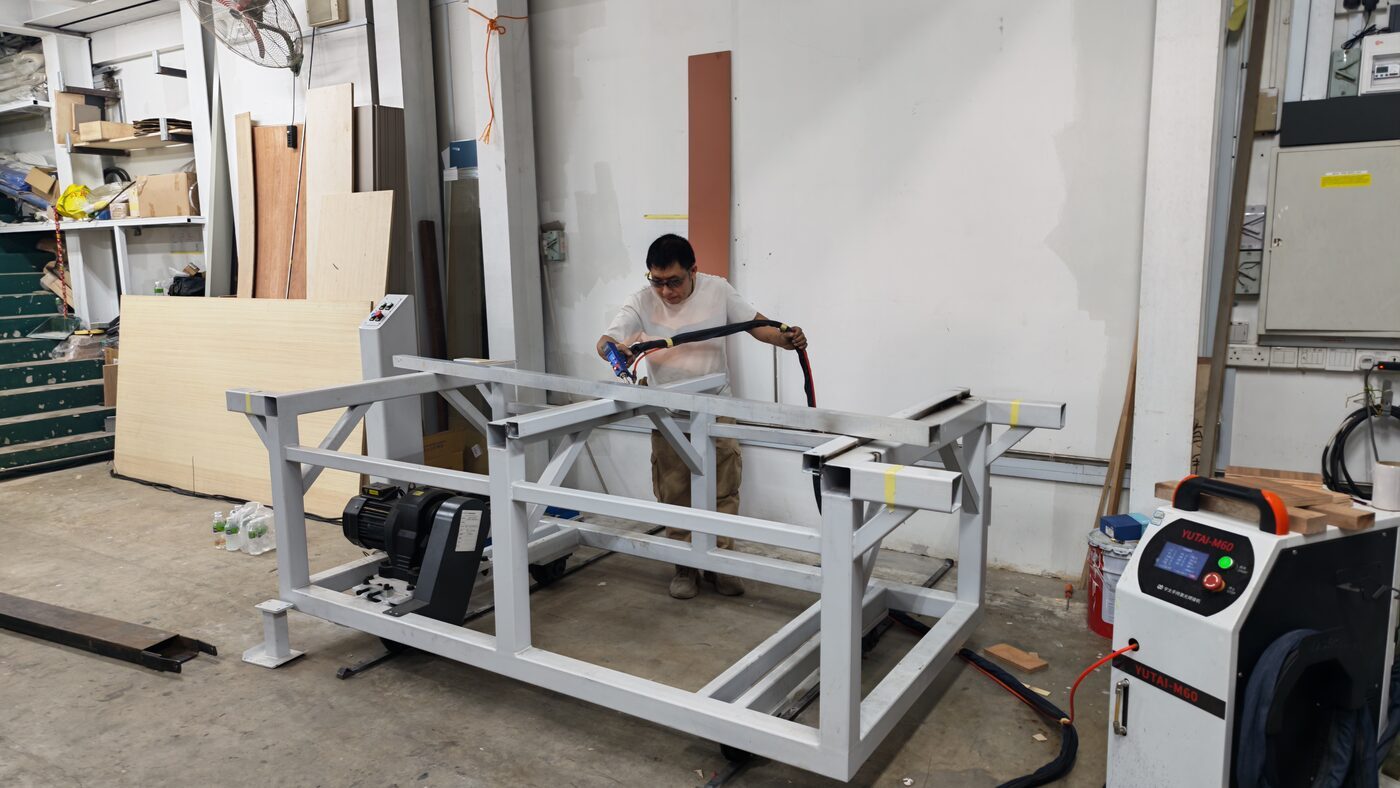
How It Differs from TIG and MIG
A TIG arc heats a fairly broad area to form a molten pool. A fibre laser concentrates its energy into a spot a fraction of a millimetre across, at a power density high enough to open a narrow vapour cavity called a keyhole. The cavity penetrates deep into the joint while the metal around it stays comparatively cool. The process travels quickly and deposits little energy per millimetre of seam, so the heat-affected zone is narrow and the total heat going into the part is a small fraction of the equivalent TIG weld.
Indicative ranges only. Actual values depend on joint design, thickness, alloy, equipment and welding parameters, and on how heat input is calculated.
Lower heat input, less distortion
Distortion is a heat problem. Reduce the heat input and distortion generally falls with it. A long stainless steel fascia or large aluminium enclosure that might visibly bow under TIG is far easier to keep straight with laser welding, given sound jigging and a sensible weld sequence. On parts that were waterjet cut specifically to avoid thermal distortion, this matters: it makes no sense to cut a component cold and then put every millimetre of movement back into it at the welding bench.
Less finishing, and better finishing
A laser seam is narrow and even. On many stainless products a light polish is the only finishing required. There is far less heat tint to remove, less grinding to blend, and less risk of the dished or over-ground appearance associated with excessive local finishing. On brushed and mirror-polished stainless steel the difference is visible at normal viewing distance.
Thin material becomes practical
Welding thin gauge stainless steel or aluminium with an arc is unforgiving, with burn-through and warping never far away. Laser welding handles thin sections comfortably, which suits enclosures, trims, decorative panels and sheet-metal assemblies where the material was chosen for weight and cost rather than for weldability.
Stainless Steel
Austenitic stainless, 304 and 316, laser welds very well. Two things decide whether the result lasts as well as it looks.
The first is shielding and back-purging. The weld and its underside have to be protected by inert gas while hot, or the surface oxidises and the chromium-rich passive layer is compromised. The second is post-weld cleaning. Heat tint is not only cosmetic. It marks a zone of reduced corrosion resistance. It should be removed, followed by the corrosion-restoration treatment required for the specified exposure. Depending on the cleaning method and the project requirements, that may include pickling, electropolishing or chemical passivation. On coastal and external work in Singapore, inadequate removal of heat tint is a common contributor to premature surface staining and localised corrosion.
Aluminium
Aluminium is harder to weld by any process. It is reflective, highly conductive, carries a tough oxide film that melts far above the parent metal, and takes up hydrogen readily enough to give porosity. Fibre lasers cope with the reflectivity, and the low heat input suits the metal, but the result depends on preparation: clean, dry, degreased joints with the oxide freshly abraded, correct shielding, and often a beam-oscillation head to widen the fusion zone and tolerate real-world fit-up.
Alloy choice matters too. The 5xxx series (5052, 5083) is meant to be welded and keeps its strength. The 6xxx extrusion alloys (6061, 6063) are heat-treatable, and every welding process softens the heat-affected zone. Laser welding keeps that zone narrow but does not eliminate it, so structural joints in 6xxx have to be designed with the softening in mind.
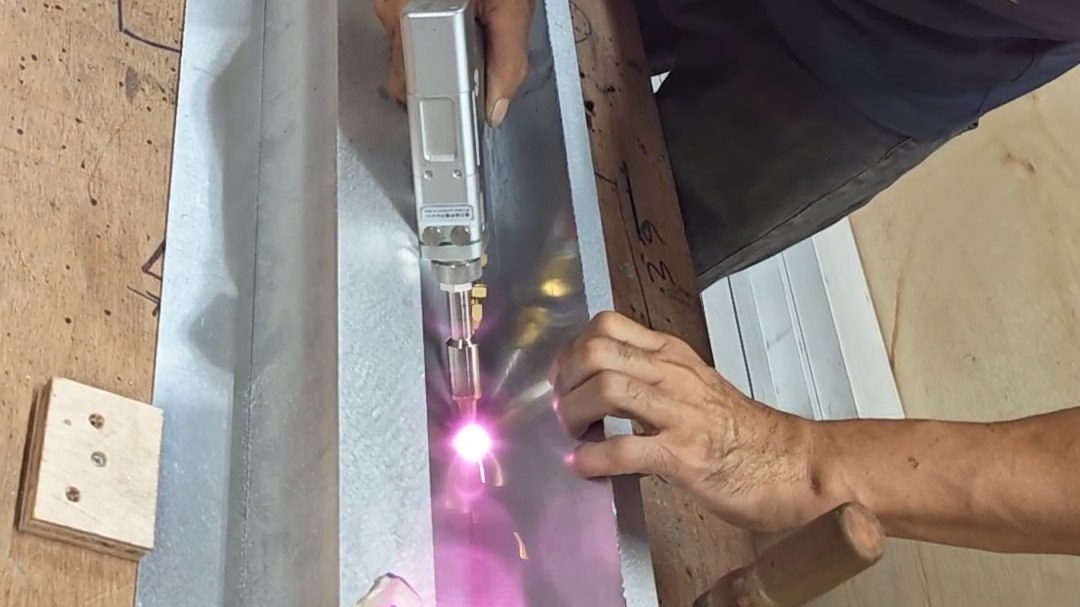
The Catch: Fit-Up Is Everything
The focused beam is narrow and has limited ability to bridge an open joint without wire feed or beam oscillation. A skilled TIG welder can fill an open joint with filler wire; laser welding needs joints that close to within a couple of tenths of a millimetre. That is exactly why it belongs downstream of precision cutting. Waterjet and laser-cut parts mate tightly. Plasma-cut and hand-sawn parts generally do not. Wire feed and beam oscillation extend the tolerance where a gap is unavoidable, but the reliable answer is to cut accurately from the start.
What the process needs from the job
- Accurate parts. Cut on waterjet or laser, deburred, dimensionally checked.
- Proper jigging. Components clamped so the joint stays closed while it is welded.
- Clean joints. Degreased, dry and oxide-abraded on aluminium.
- Correct shielding. Including back-purging on stainless where the reverse face is visible or exposed.
- Post-weld treatment. Heat tint removed and stainless passivated for external or coastal service.
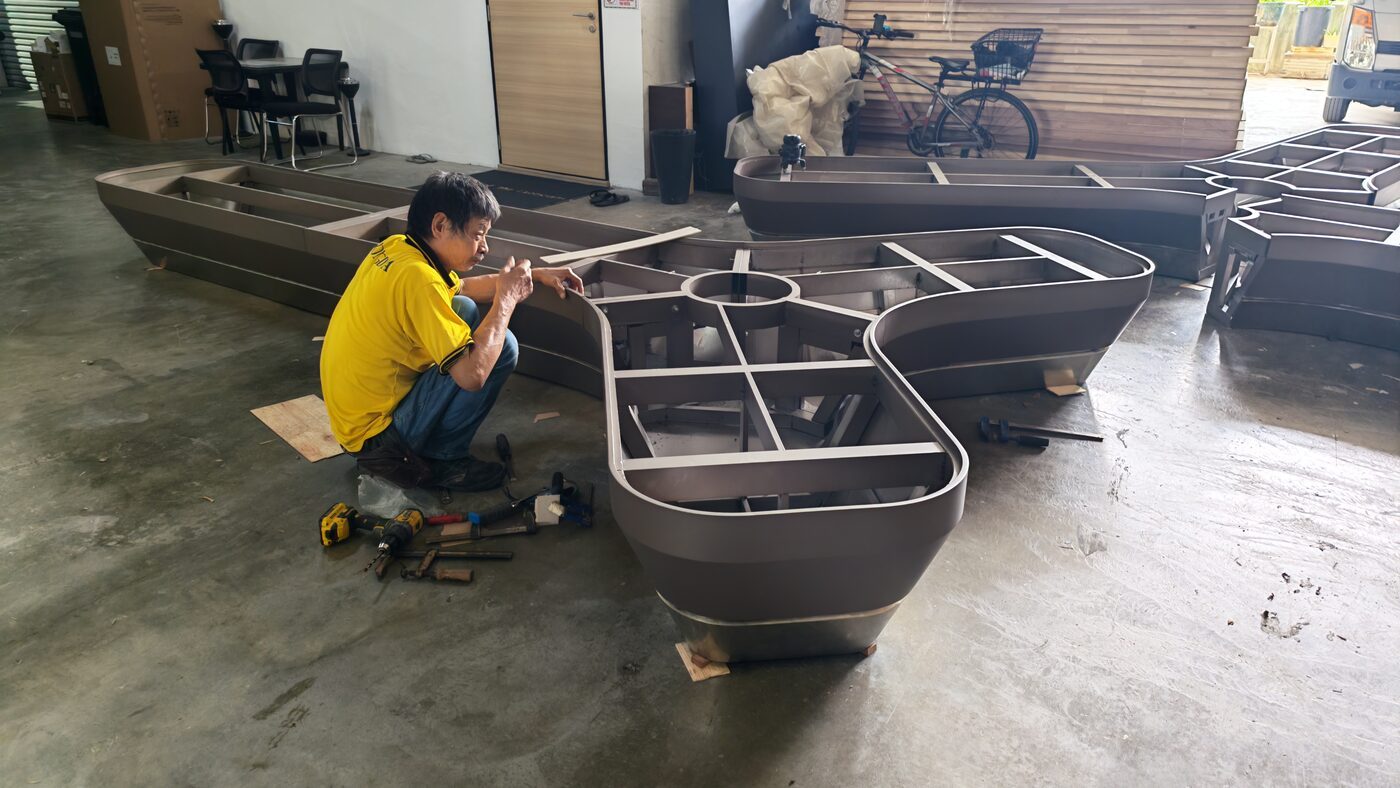
Where We Use It
- Architectural stainless. Reception counters, cladding panels, column casings, handrails, balustrade components.
- Aluminium assemblies. Screens, gates, planters, louvre frames, trellis modules, equipment enclosures.
- Hygienic fabrication. Food-service and laboratory furniture, where smooth cleanable seams are a requirement rather than a preference.
- Thin-gauge sheet metal. Trims, covers, boxes and brackets that would warp under an arc.
Laser welding does not replace arc welding for every joint. Heavy structural sections, large fillet welds and site repairs remain arc work. The skill is knowing which joint belongs to which process, and saying so before the job is priced rather than after it is welded.
Frequently Asked Questions
Is a laser weld as strong as a TIG weld?
For a correctly designed and executed joint, yes. A full-penetration laser weld develops the strength of the joint it replaces, and the narrow fusion zone is usually an advantage. The limitation is geometric rather than metallurgical: laser welding suits close-fitting butt, lap and edge joints, while large fillets on heavy section stay arc work.
Can you laser weld aluminium to stainless steel?
Dissimilar aluminium-to-steel joints form brittle intermetallic compounds, and we would not offer one as a standard structural joint. Where a design needs the two metals connected we detail a mechanical fixing or a transition instead, and we raise it at drawing stage rather than after fabrication.
Will the welds show on a polished stainless counter?
Done properly, barely. The narrow seam and minimal heat tint mean a light dress and polish blends the joint into the surrounding grain. On mirror finishes we plan the joint positions at drawing stage so seams land where they are least conspicuous.
Do you weld parts cut by another supplier?
Yes, subject to inspection. Fit-up decides whether laser welding is viable at all, so we check incoming parts for gap, squareness and edge condition first. If they will not close tightly we will tell you, and either prepare the edges or advise that the joint is better made by arc welding.
Is post-weld passivation really necessary?
For external, coastal, wet or hygienic service, heat tint should be removed and the required corrosion-restoration treatment confirmed against the project specification. Depending on the cleaning method and the service environment, that may include pickling, electropolishing or chemical passivation. Heat tint is a thinned, chromium-depleted oxide layer, and leaving it in place can contribute to premature staining and localised corrosion in service.
The information in this article is general project guidance. Final material grades, fabrication methods, tolerances and acceptance criteria should be confirmed against the project specification, approved drawings, applicable standards and actual site conditions.
- Waterjet Cutting for Thick Aluminium and Stainless Steel Plate
- Waterjet, Laser or Plasma? Choosing a Cutting Process for Aluminium and Stainless Steel
- 304 or 316 Stainless Steel? Specifying, Cutting and Welding for Singapore’s Climate
- Specifying and Verifying Low-Formaldehyde Plywood on Singapore Projects
More in Metal Fabrication
 Integrated Glass, Aluminium & Metal Components in Imported Furniture: Why Luxury FF&E Needs Multi-Trade Installation Coordination in Singapore
 Waterjet Cutting for Thick Aluminium and Stainless Steel Plate in Singapore
 Waterjet, Laser or Plasma? Choosing a Cutting Process for Aluminium and Stainless Steel