
In a humid, coastal, chloride-rich environment, the grade you specify and the way the edges and welds get treated decide whether stainless steel stays stainless.
Related service: metal fabrication in Singapore.
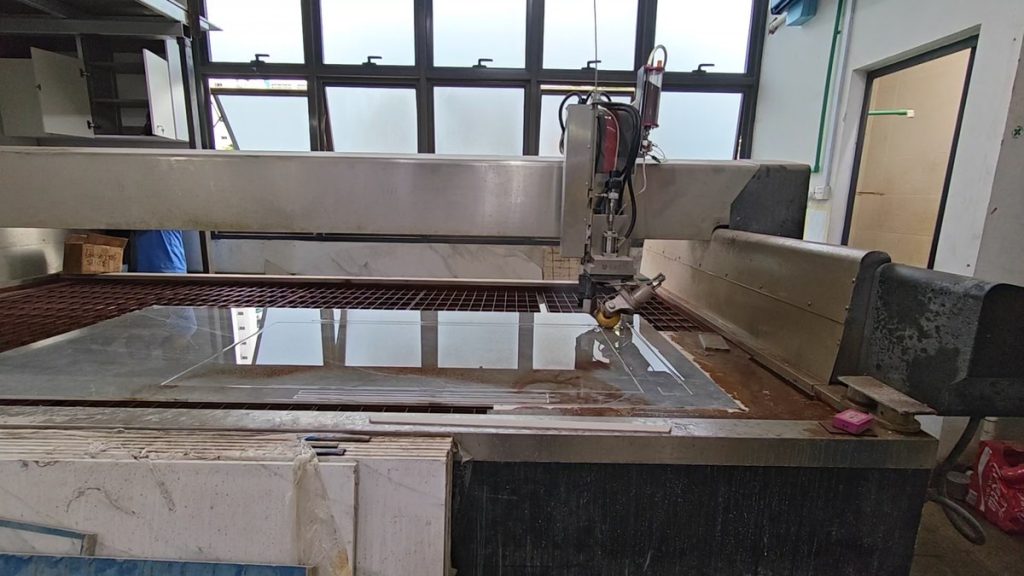
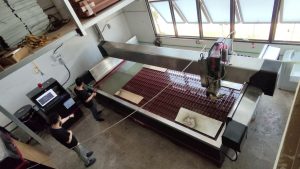
We fabricate stainless steel metalwork in Singapore for interior, exterior, wet-area and coastal exposure, with the grade and finish chosen for where the item will actually live. Marine and coastal plate is cut cold on our waterjet, so the cut edge reaches the welder in the same condition as the rest of the sheet.
Many cases of premature staining or corrosion on stainless steel here can be traced to one or more of three causes. The wrong grade was specified for the exposure. The surface was contaminated during fabrication or installation. Or heat tint from welding was never removed. None of those is a defect in the metal, and all three are manageable.
What Makes Stainless Steel Stainless
Singapore is an island with a tropical rainforest climate: warm and humid all year, with airborne chlorides from the sea and sulphur dioxide from traffic and industry. Those are precisely the conditions that drive pitting and crevice corrosion in stainless steel, which is why grade selection here is less forgiving than in a temperate, inland market.
Stainless steels carry enough chromium, at least around 10.5%, to form a thin self-repairing chromium-oxide film on the surface. That passive layer is what resists corrosion, and it re-forms by itself when the surface is scratched, as long as oxygen can reach it and the surface is clean.
Anything that blocks or contaminates the film sets up the conditions for rust, even on a perfectly good grade. Embedded carbon steel particles, adhesive residue, heat tint, dirt packed into a crevice: any of them will do it.
304 and 316: The Practical Difference
Both are austenitic, non-magnetic when annealed, easy to form and readily weldable. The difference that counts is molybdenum. 316 has roughly 2% to 3% of it, 304 has none, and molybdenum sharply improves resistance to pitting and crevice corrosion in chloride environments. Which is to say: anywhere near the sea, near a pool, or in a wash-down area.
| Grade 304 / 304L | Grade 316 / 316L | |
|---|---|---|
| Key alloying | ~18% Cr, ~8% Ni | ~17% Cr, ~10% Ni, 2–3% Mo |
| Chloride resistance | Moderate | Much better |
| Pitting resistance (PREN) | ≈18–20 | ≈24–26 |
| Relative cost | Baseline | Roughly 25–50% higher |
| Suits | Interior fit-out, dry areas, general architectural work | External, coastal, wet, pool, marine, chemical, food-processing |
The “L” suffix means a low-carbon variant. 304L and 316L resist sensitisation: during welding, chromium and carbon combine into chromium carbides at the grain boundaries, locally depleting chromium and leaving the metal open to intergranular corrosion along those boundaries. For welded fabrications in thicker section, or anything corrosive, the L grade is cheap insurance. Modern melting practice means most commercial plate is dual-certified anyway, but it is still worth stating on the drawing.
Choosing a Grade for a Singapore Project
- Interior, air-conditioned, dry. 304 is generally suitable: counters, cladding, trims, internal balustrades, office and retail metalwork.
- Semi-exposed or humid. Covered walkways, car parks, bin centres, M&E and plant rooms, and kitchens that are washed down frequently. Use 316 here, and match the fixings to it.
- External, coastal or marine. Facade cladding, jetties and boardwalks, pool surrounds, drainage channels, roof-level plant and any seafront work. 316 or 316L is commonly specified as a minimum, with a smoother surface finish and a planned cleaning regime. Final selection still depends on chloride exposure, detailing and the project specification.
- Fixings and fasteners. Specify them at no lower a grade than the parent material. A lower-grade fastener on a 316 panel becomes the assembly’s corrosion weak point, particularly in wet or chloride-exposed service, and it is the hardest item to change later.
Surface finish belongs in the corrosion specification, not only in the aesthetic one. A smoother finish gives contaminants less to key into and washes clean more readily, so external work should call for a finer brushed or polished finish rather than a coarse mill surface.
How Fabrication Undoes a Good Specification
Iron contamination
A common cause of apparent rusting on stainless steel is not the stainless steel at all. It is carbon steel particles picked up from a grinding disc, wire brush or workbench that was last used on mild steel. Those particles rust, and the stain looks exactly like a panel failure. Stainless work needs segregated tools, segregated benches and clean handling. That is a discipline rather than a technique.
Heat-affected and heat-tinted edges
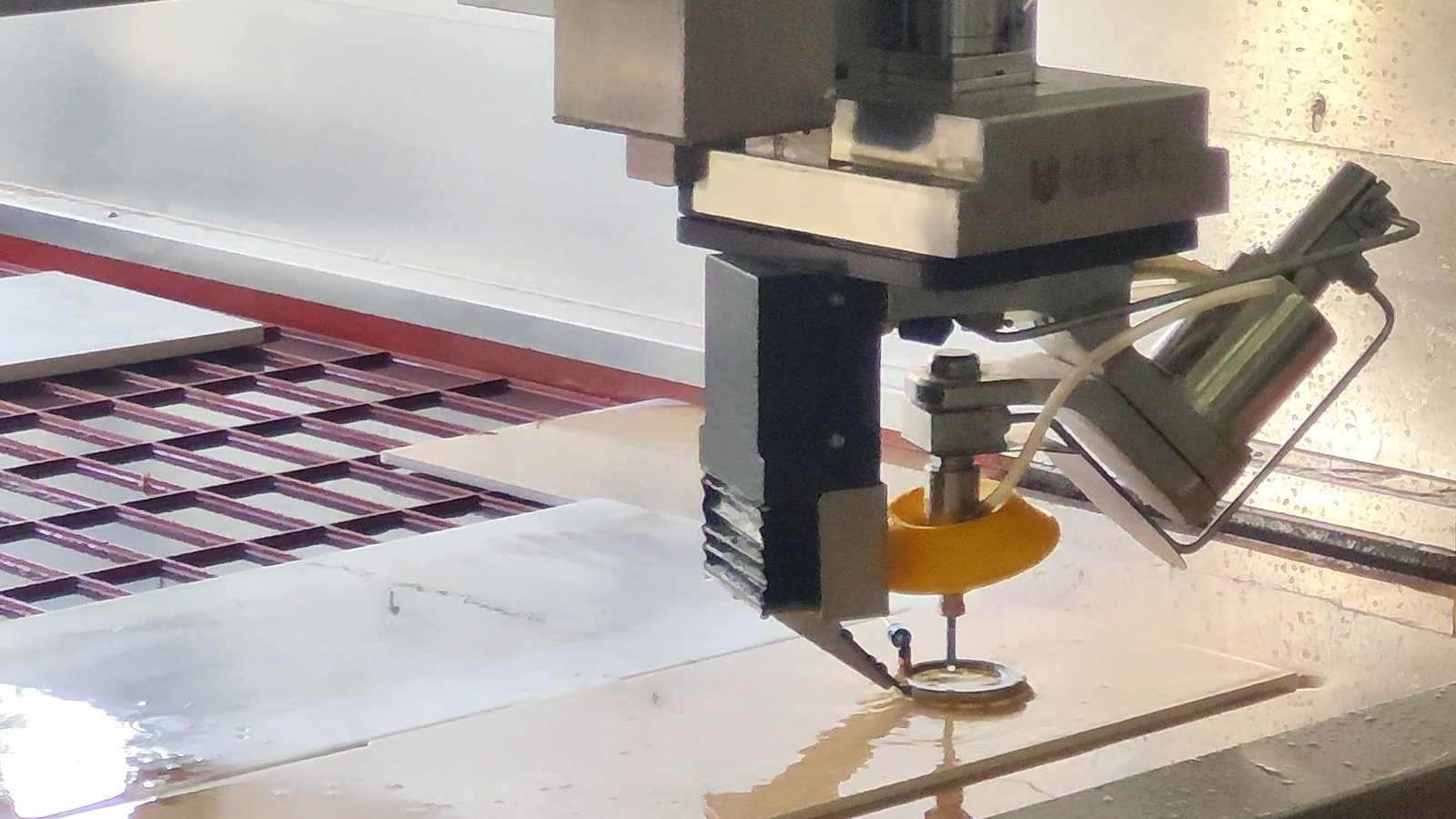
Thermal cutting and welding both change the edge. Plasma leaves a wide oxidised band, laser cutting a narrower one, and welding leaves the familiar straw-to-blue tint. That tint is chromium-depleted oxide and it corrodes preferentially, which is why a thermally cut edge is usually the first place a stainless steel fabrication starts to rust. It is also the reason marine-grade stainless steel so often gets specified for waterjet: cold cutting removes the problem at source, leaving no heat-affected zone to restore.
Where heat is unavoidable, the edge needs dressing and then the corrosion-restoration treatment appropriate to the exposure. In practice that usually means grinding or abrasive cleaning to remove the oxide, followed by pickling and passivation to rebuild the passive film. Confirm the required route against the project specification, since electropolishing or other treatments may be called for instead.
Crevices and trapped water
Crevice corrosion needs only a tight gap, moisture and chlorides. Detailing that lets water drain, avoids unsealed lapped joints, and stops dirt packing into corners does more for long-term appearance than an upgrade in grade. Good detailing, an appropriate grade, a suitable finish and planned maintenance together give an external facade the best chance of still looking right years after handover.
How we handle stainless
- Cold cutting. Our waterjet for thick and marine-grade plate, which leaves the edge microstructure and passive layer intact; our fibre laser for thin sheet, with the edges dressed and treated afterwards.
- Low-heat joining. Our fibre laser welding for finish-critical seams, or well-controlled arc welding where the section demands it, back-purged where the reverse face is exposed. Keeping heat input down is what limits chromium-carbide formation and the intergranular corrosion that follows it.
- Segregated handling. Dedicated stainless tools, discs and benches, to keep iron out of the surface.
- Post-weld cleaning. Heat tint removed, then pickling and passivation to rebuild the chromium-oxide film over the weld zone, or whichever corrosion-restoration route the specification requires, with the finish blended to the required grain.
- Protection to site. Peelable film kept on through delivery and installation, taken off at handover.
Frequently Asked Questions
Is 316 always worth the extra cost?
No. In a dry, air-conditioned interior, correctly fabricated and maintained 304 is usually adequate, so the 316 premium may bring limited practical benefit. We apply an exposure test: if it will get wet, be washed down, or see salt air, specify 316. As a working rule, fasteners and fittings should be no lower a grade than the parent material: a lower-grade screw on a 316 panel becomes the point where corrosion starts, and fixings are the hardest items to replace later.
My stainless handrail has rust spots. Is it fake stainless?
Surface staining does not necessarily mean the material is not stainless steel. Rust freckles commonly result from embedded iron contamination or untreated heat tint. Cleaning and re-passivating the affected areas normally resolves it. If the pitting is deep, the exposure probably called for a higher grade in the first place.
Can you supply mill certificates?
Yes, traceable to the plate or sheet used on your job. Worth asking for at order stage on any project where the grade is a contractual requirement rather than a preference.
Does waterjet cutting really improve corrosion resistance?
At the cut edge, yes. Because the process is cold, the edge keeps the parent material’s composition and condition, with no heat-affected zone and no oxide scale to clean off. On coastal and marine work that is a specifiable advantage rather than a marketing line.
The information in this article is general project guidance. Final material grades, fabrication methods, tolerances and acceptance criteria should be confirmed against the project specification, approved drawings, applicable standards and actual site conditions.
More in Metal Fabrication
 Integrated Glass, Aluminium & Metal Components in Imported Furniture: Why Luxury FF&E Needs Multi-Trade Installation Coordination in Singapore
 Waterjet Cutting for Thick Aluminium and Stainless Steel Plate in Singapore
 Waterjet, Laser or Plasma? Choosing a Cutting Process for Aluminium and Stainless Steel