

For many custom furniture projects, stone worktops are best measured after the supporting cabinets have been installed and levelled on site. Although overseas pre-cutting is possible, differences between approved drawings and actual site conditions can create fitting risks, especially around walls, sinks, hobs and service openings.
Related service: FF&E installation services in Singapore.
Quartz, marble and sintered-stone worktops are heavy and may be difficult to modify after fabrication. Where walls, cabinets, sinks or appliances have limited installation tolerances, on-site templating after cabinet installation generally provides better control over the final fit.

When Local Stone Templating Is the Safer Option
Cabinets may require levelling and adjustment during installation, while walls are not always perfectly straight. Cut-outs for sinks, hobs, taps and other fittings must also coordinate with the cabinets and services below.
Pre-cut stone may be suitable where verified final dimensions and adequate installation tolerances are available. For fitted kitchens, vanity units and custom counters, however, templating after cabinet installation generally provides better control over wall profiles, joints, overhangs and appliance openings.
On-Site Templating After Cabinet Installation
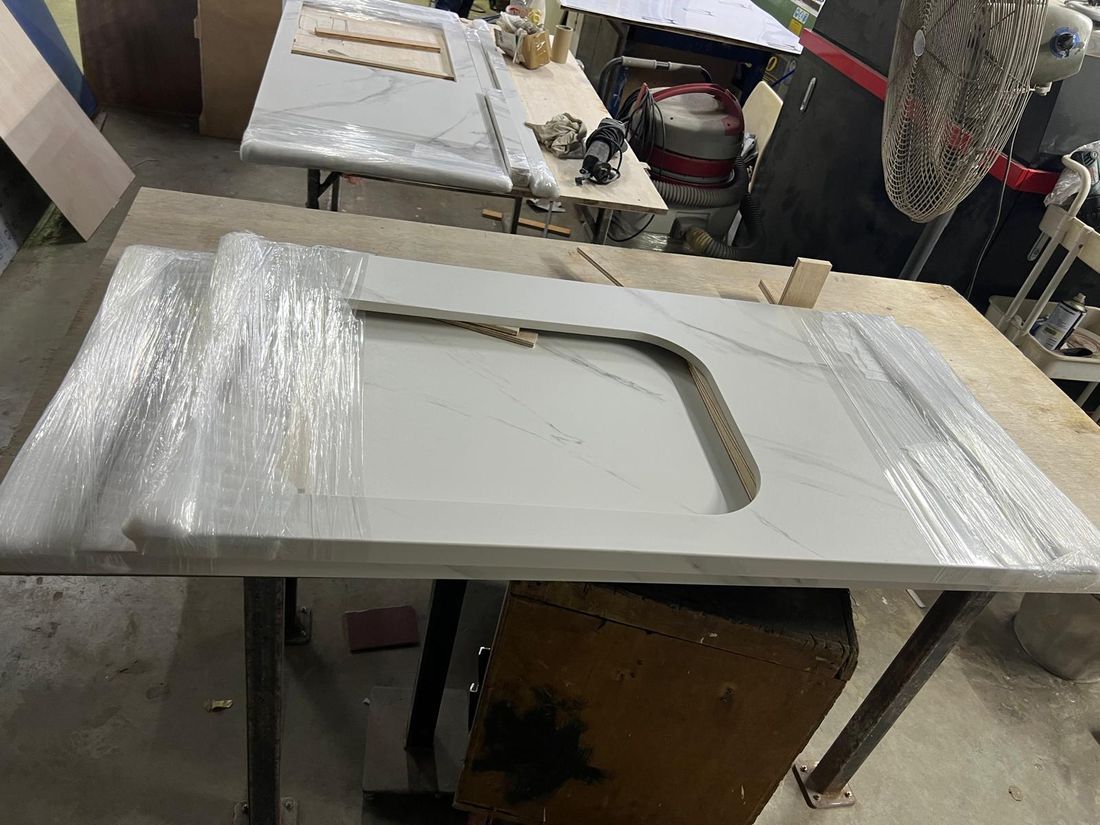
We template on site after the supporting cabinets have been installed and levelled, recording the relevant dimensions, wall profiles, joint positions and appliance cut-outs. Careful templating helps the fabricator prepare the worktop to suit the verified installed conditions.
Before templating begins, the sink, hob, tap and appliance models should be confirmed. The proposed edge profile, overhang, splashback and joint locations should also be agreed before fabrication.
Quartz, Marble and Sintered Stone
Choosing the right surface:
- Quartz — consistent in appearance, durable and relatively low-maintenance for kitchens and vanity tops
- Sintered stone — suitable for large-format surfaces and applications requiring good resistance to heat and scratching, subject to the selected product
- Marble and natural stone — valued for their natural colour and veining, with variations and maintenance requirements that should be understood before selection
Natural stone may include variations in colour, pattern, veining, pores and fissures. Samples and slab photographs can help with selection, but they may not represent every part of the finished surface.
Fabrication and Installation
After templating, the selected slabs can be cut, edge-profiled, drilled and polished according to the approved requirements. The completed pieces are then transported to site, positioned on the supporting cabinets, joined and sealed as required.
The fabrication and installation method depends on the material, slab size, edge detail, joint arrangement, access conditions and supporting cabinet construction.
Depending on the agreed scope, Rongda Pacific can coordinate measurement, fabrication and installation through one local point of communication. The quotation should clearly state the responsibilities for measurement, material supply, fabrication, installation, rectification and warranty support.
Access, Handling and Installation Planning
Stone worktops may be large, heavy and fragile during handling. Before fabrication, the project team should review the route from the delivery vehicle to the installation area.
- Lift dimensions and weight limits
- Door, corridor and staircase widths
- Turning space and temporary storage
- Required manpower and lifting equipment
- Protection of floors, walls and completed finishes
- Final joint and installation locations
Information We Need Before Templating
- Approved cabinet drawings
- Sink, hob, tap and appliance model numbers
- Selected stone material and slab information
- Edge-profile requirements
- Splashback requirements
- Proposed joint locations
- Overhang dimensions
- Access and lifting restrictions
- Expected templating and installation dates
Frequently Asked Questions
Can stone worktops be fabricated overseas?
Yes. The result depends on the accuracy of the final dimensions, wall conditions, cabinet levelling, cut-out positions and available installation tolerances. For tightly fitted custom worktops, measuring after cabinet installation often provides better control over the final fit.
When should the worktop be measured?
For many fitted installations, templating should take place after the supporting cabinets have been installed, levelled and fixed in their final positions. Sink, hob and appliance information should also be available before measurement.
Which stone material should I choose?
The choice depends on the intended use, appearance, maintenance expectations, budget and project requirements. Quartz is commonly selected for practical everyday surfaces, while sintered stone and natural stone may suit different design and performance needs.
Do you measure, fabricate and install the stone?
Depending on the agreed scope, we can coordinate on-site measurement, local fabrication and installation. The quotation will identify the included materials, services and warranty responsibilities.
Will natural stone look exactly like the sample?
Not necessarily. Marble and other natural stones vary in colour, veining and surface characteristics. Slab selection and layout review can help manage expectations before cutting begins.
Can the worktop be modified on site?
Minor adjustments may sometimes be possible, depending on the material and required change. Major changes, incorrect openings or unsuitable dimensions may require workshop refabrication or replacement.
Request a Stone Measurement Assessment
- Why Professional Site Measurement Is Essential for Imported Furniture Projects
- Scribing, Fillers & Making Good for Imported Furniture
- Dimensional Control for Imported Furniture: Datums, Hold Points and Revisions
- Integrated Appliances & Imported Cabinetry
- Stone Dry-Lay, Vein Matching & Final Templating for Imported Furniture
Send your cabinet drawings, appliance information, preferred material, site photographs and project programme to [email protected] for an itemised quotation, or visit www.rongdacontractor.com.
More in FF&E Installation
 Rectifying FF&E in a Hotel That Has Already Opened: Room Nights, Housekeeping Access and the Remove-and-Return Cycle
 How Many Spares Should an Imported FF&E Package Carry? A Risk-Based Alternative to the 2% Line
 Large Residential Development FF&E in Singapore: Unit-by-Unit Handover, Defect Patterns and a Liability Period in Occupied Homes