
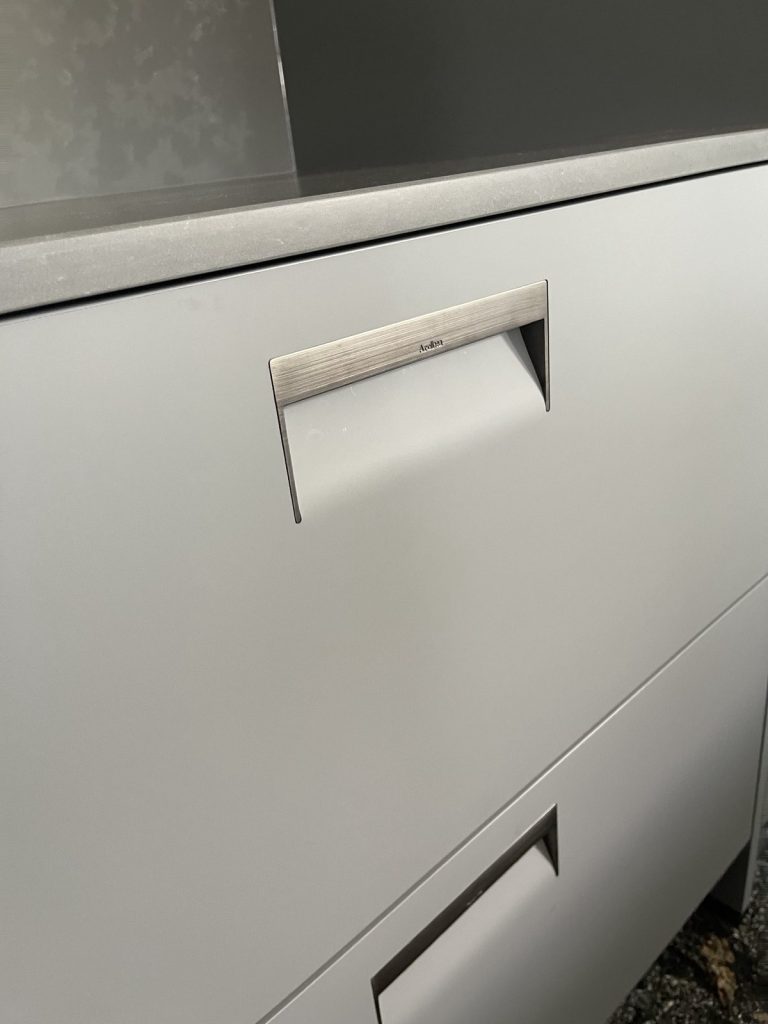
Overseas factories can manufacture cabinetry with impressive precision — a wardrobe built exactly to shop drawings, a feature wall CNC-cut to specific dimensions, a reception counter with accurately positioned joints and hardware. Yet once the furniture reaches the Singapore site, one fact becomes unavoidable: real walls, floors and ceilings are not always perfectly straight, level or square.
Related service: FF&E installation services in Singapore.
A wall may bow slightly, a corner may not be exactly 90 degrees, a floor may vary by a few millimetres, a ceiling may dip across a long cabinet run. These are normal parts of real construction. The challenge is not to pretend they do not exist — it is to install precision-made furniture so the final result still appears intentional, straight and refined. That is where levelling, scribing, filler panels, controlled trimming and making good become essential.
What Is Scribing — and Why Imported Furniture Needs It
Scribing is the process of accurately adapting a furniture edge or filler to follow an uneven adjacent surface. A full-height cabinet may sit beside a wall that looks straight but varies by several millimetres top to bottom; instead of pushing a straight filler against it and leaving visible gaps, the installer marks the actual wall profile onto the filler and trims it to follow the wall. It is commonly used around wardrobes, tall cabinets, kitchen units, feature walls, wall panelling, reception counters and built-in shelving.
Locally fabricated furniture can sometimes be measured very late; imported furniture is often manufactured earlier, before every final finish is complete. That raises the chance the installation condition differs slightly from the original measurement — final plaster thickness, tiling build-up, skirting, ceiling finishing, floor levelling, final paint or M&E modifications. The differences may be small, but premium furniture makes small differences visible: a 5 mm irregular gap beside a full-height luxury wardrobe can distract even when the cabinet is perfectly made.
Fillers Absorb Tolerance — the Furniture Front Stays Straight
A filler panel is often treated as a minor accessory, but it performs real functions — absorbing wall tolerance, ceiling variation, skirting projection and installation clearance while helping maintain the cabinet’s intended visible geometry. If a wardrobe stands beside a slightly uneven wall, the installer keeps the cabinet front perfectly straight and uses the filler to absorb the irregularity, rather than twisting the whole cabinet to follow the wall.
This is the key principle: distinguish the building line from the furniture line. Forcing a cabinet to follow an uneven wall makes door fronts step in and out, shadow gaps become inconsistent and long horizontal lines look distorted. Professional installers keep the visible furniture face straight and use packing, levelling, fillers, scribing and concealed support to absorb normal tolerances behind or beside the cabinet. The client sees the furniture front — that is where visual control matters most.
Long Runs, Floors and Ceilings Magnify Small Errors
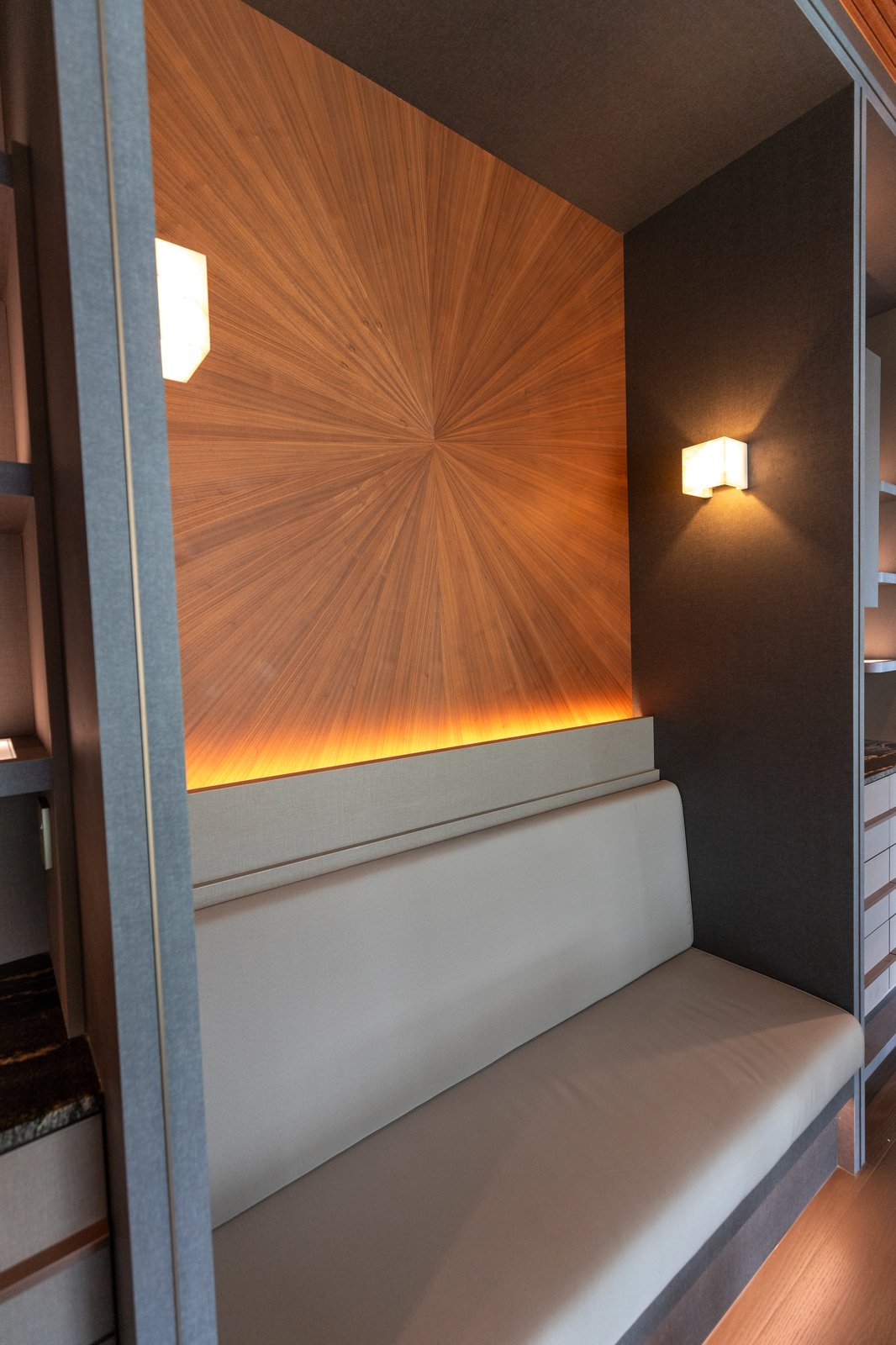
A small tolerance is almost invisible on a 600 mm cabinet; across a 5-metre wardrobe or feature wall the same issue becomes obvious, revealing floor slope, ceiling variation, wall bowing and accumulated module differences. Long runs should be set out from a controlled reference line rather than installing one cabinet after another against the wall.
Tall furniture is very sensitive to floor variation — an unlevel base shows up higher as uneven door gaps, misaligned top panels and drawer fronts out of line. Level the cabinet base before final door and hardware adjustment. Floor-to-ceiling cabinetry looks elegant but leaves little room to hide variation, so ceiling tolerance is managed through top fillers, closing panels, shadow gaps and scribed trims. For overseas manufacturers, it is valuable to design full-height furniture with a realistic local installation allowance rather than assuming every ceiling is perfectly flat.
Shadow Gaps, Skirting and Irregular Architecture
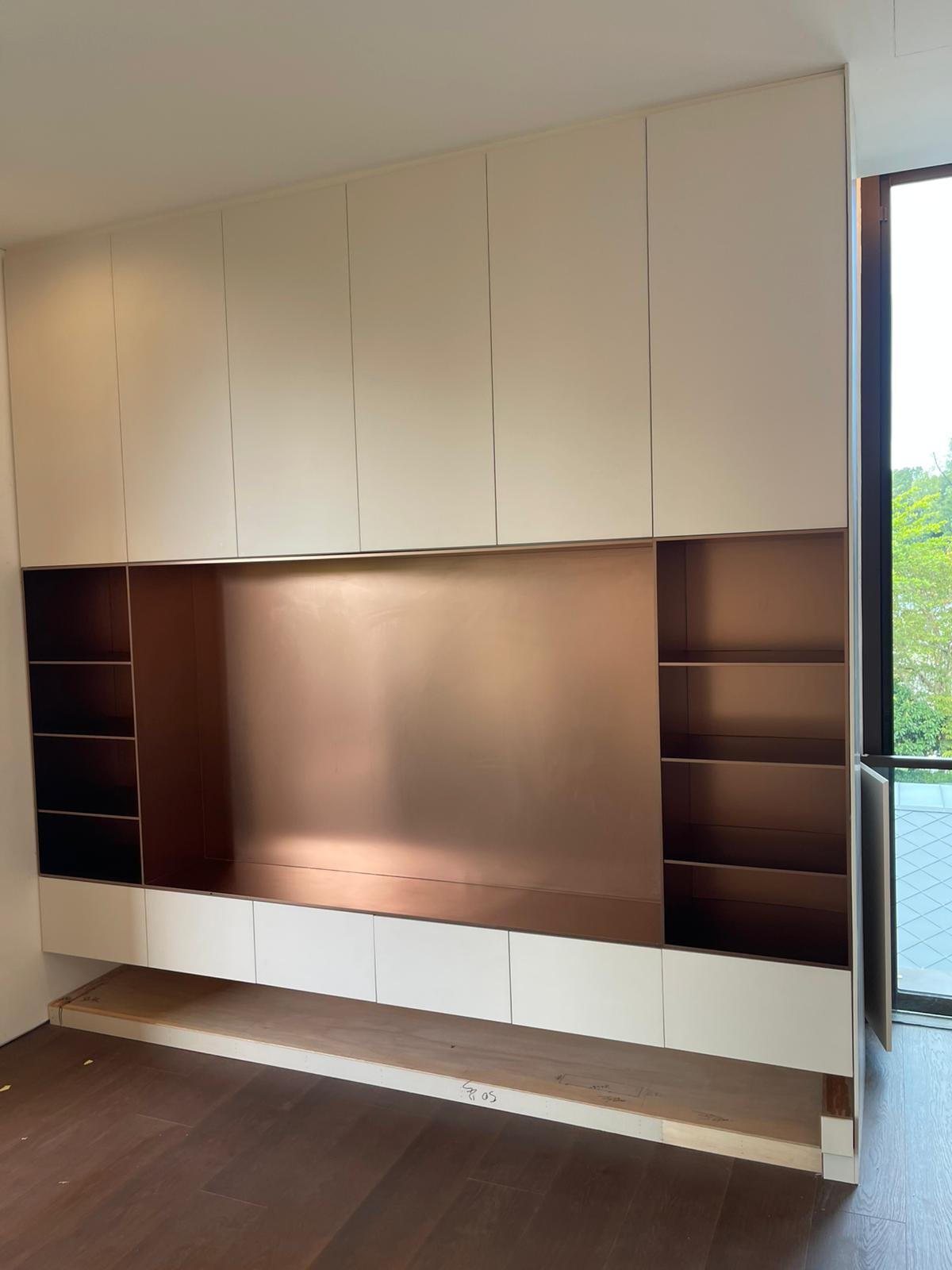
Modern luxury furniture often uses deliberate shadow gaps — between cabinet and wall, below suspended cabinets, above feature panels. A shadow gap only looks intentional when it is consistent; if it changes width because of site variation, the design looks poorly executed. Installers distinguish an intentional shadow gap from an uncontrolled installation gap, and base the shadow line on the approved design rather than whatever space happens to remain.
Existing skirting is a common conflict — a cabinet designed to sit tight against the wall meets skirting projecting into its footprint, resolved deliberately through a furniture notch, skirting adjustment, filler or Builder’s Works rather than random on-site cutting. Luxury interiors also include structural columns, curved walls and uneven masonry; scribing lets a panel follow an irregular edge while the visible furniture face stays consistent — translating irregular architecture into a clean furniture interface.
Local Trimming Must Respect the Finish
Not every panel can be trimmed casually. Imported furniture may use natural veneer, laminate, lacquer, decorative metal or wrapped finishes, and cutting one edge can expose raw substrate or a different colour. The installer must know whether the cut edge will be hidden, re-edged, covered by a trim or visible before modifying the component — for premium visible finishes, the original factory may need to supply a replacement or dedicated filler. Natural veneer is directional, so a locally made filler can be technically correct yet look wrong if grain direction, colour or veneer cut differs; visible decorative elements are often better supplied by the original manufacturer when exact matching is critical.
Making Good Completes the Installation
Furniture work affects surrounding finishes — drilling, removing skirting, opening small wall areas, adjusting services and cutting around existing finishes. After the furniture is installed, the surrounding area may need plaster repair, painting, silicone, skirting reinstatement and ceiling or wall touch-up. This is making good: the furniture may be complete, but the installation is not fully complete until the surrounding building finishes are restored appropriately. An installation partner with Builder’s Works capability can coordinate these interfaces more efficiently instead of calling a separate contractor for every small junction.
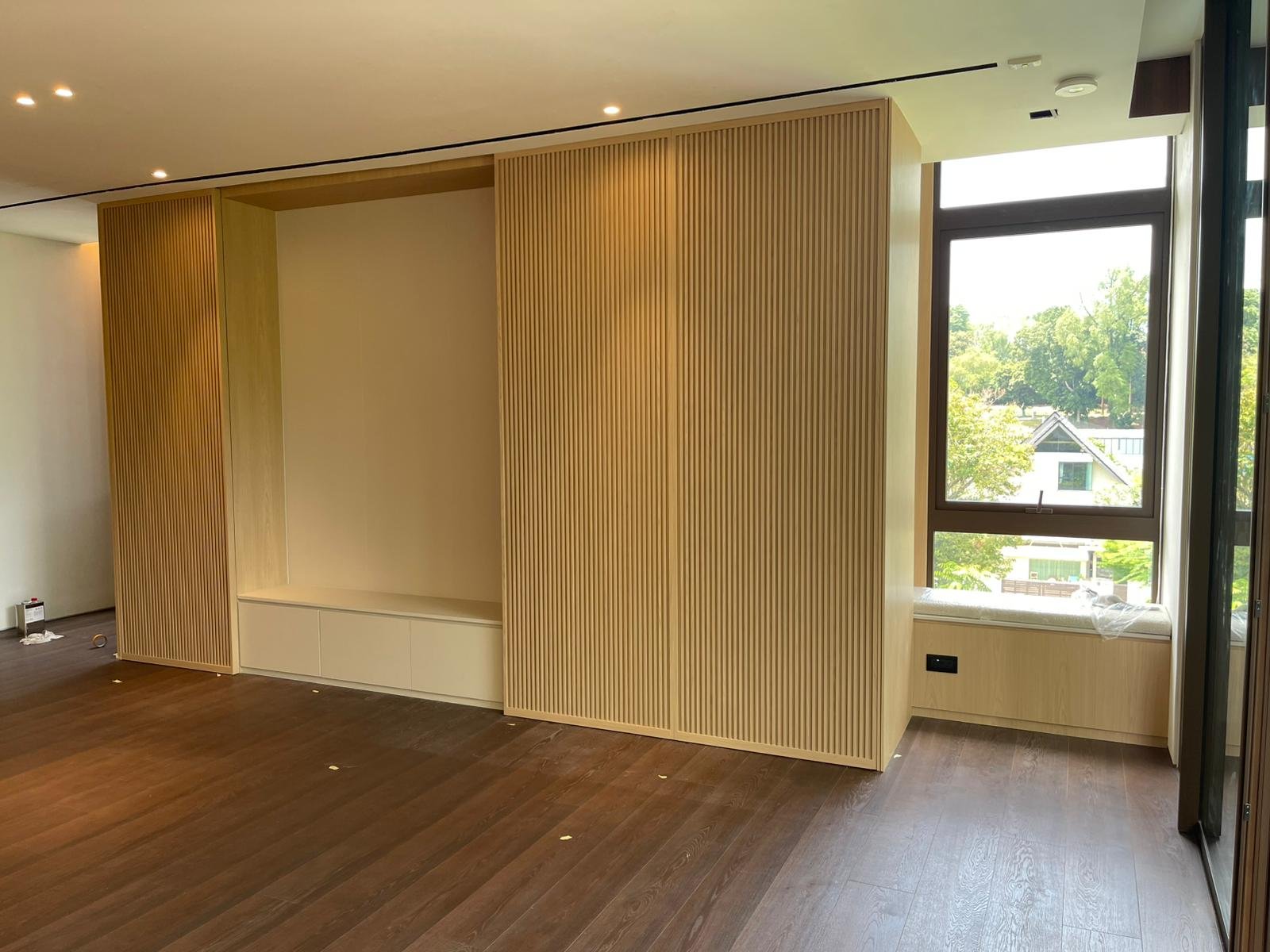
Silicone is for appropriate finishing joints, not for hiding large errors — a big irregular gap filled entirely with silicone looks poor and emphasises the underlying tolerance. Larger gaps should be controlled with correctly sized fillers, proper scribing, adjusted trims and Builder’s Works before final silicone. For repetitive projects, the first installed unit can establish the standard filler width, scribing detail, shadow gap, silicone finish and ceiling closure so every crew works to the same approved benchmark.
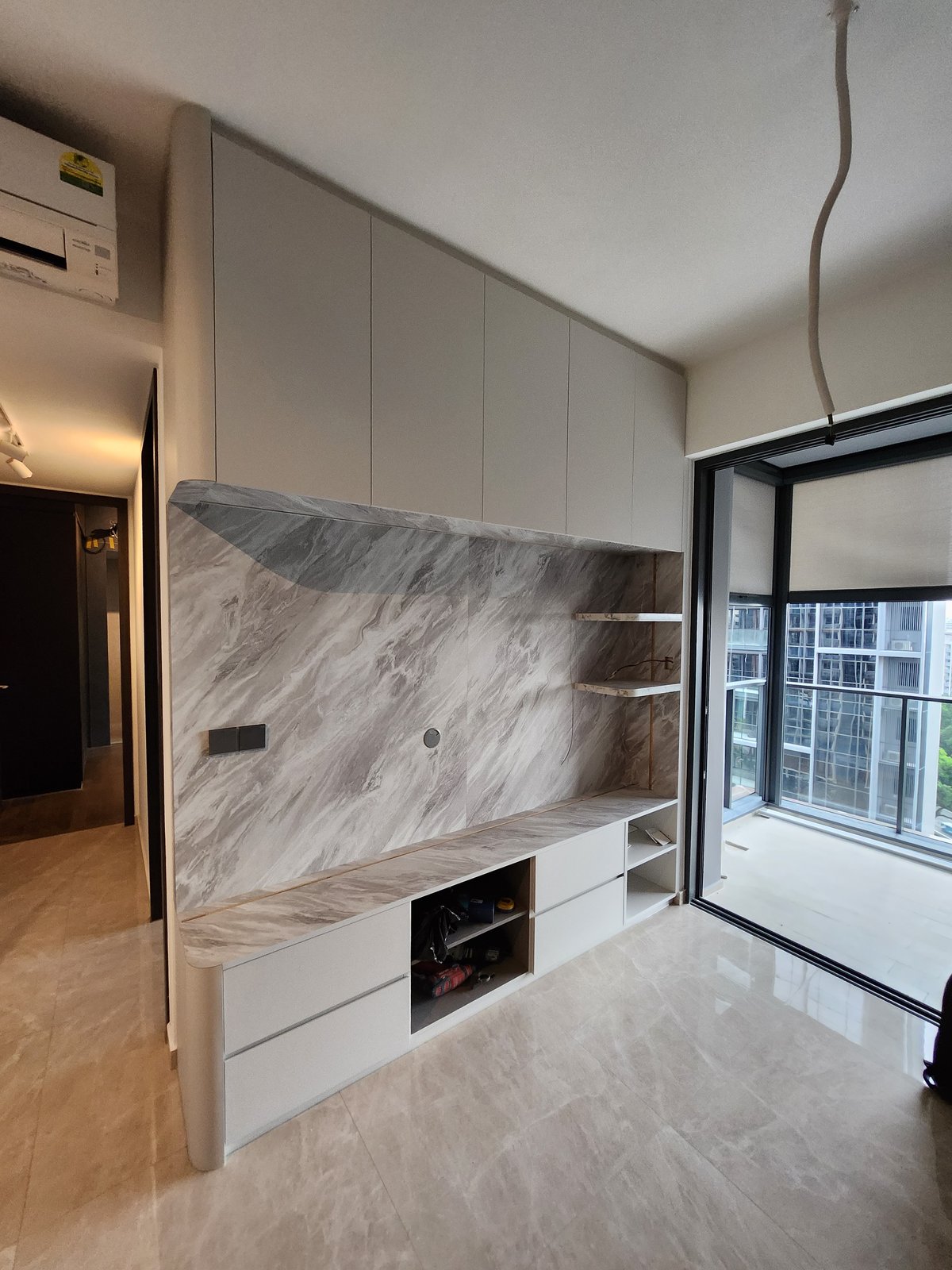
A Practical Site-Tolerance Workflow
How Rongda Pacific Supports Imported Furniture Site Fitting
Depending on project requirements, Rongda Pacific Pte Ltd can support pre-installation site verification, imported-furniture receiving coordination, site measurement, furniture levelling, scribing, filler installation, local carpentry modification, full-height wardrobe and feature-wall installation, Builder’s Works, wall and skirting interfaces, stone and glass coordination, making good, snagging, defect rectification and final handover — adapting precision-manufactured furniture to actual building conditions.
Frequently Asked Questions
What is furniture scribing?
Marking and trimming a furniture edge or filler to follow an irregular adjacent wall, ceiling or architectural surface.
Why does imported furniture need fillers?
Fillers absorb normal site tolerances, provide installation clearance and help maintain a straight visible cabinet line.
Does using fillers mean the furniture was measured incorrectly?
Not necessarily. Real buildings have tolerances, and fillers are often intentionally designed as part of professional built-in furniture installation.
Can visible veneer fillers be made locally?
Sometimes, but colour and grain matching can be difficult. For premium visible areas, original-factory supply may be preferable if exact matching is required.
Why is cabinet levelling important?
An unlevel cabinet causes uneven door gaps, drawer misalignment and poor visual lines, especially on full-height furniture.
Can silicone be used to close all wall gaps?
Silicone suits appropriate finishing joints; larger or irregular gaps should be addressed through proper fitting, fillers, scribing or Builder’s Works.
What is making good?
Repairing or restoring surrounding building finishes affected by installation — paint, plaster, skirting or silicone.
- Why Professional Site Measurement Is Essential for Imported Furniture Projects
- Dimensional Control for Imported Furniture: Datums, Hold Points and Revisions
- On-Site Stone Measurement and Local Fabrication
- High-Level & Oversized Imported Furniture Installation
- Stone Dry-Lay, Vein Matching & Final Templating for Imported Furniture
- Stone and Solid-Surface Coordination in Commercial FF&E Fit-Out
More in FF&E Installation
 Rectifying FF&E in a Hotel That Has Already Opened: Room Nights, Housekeeping Access and the Remove-and-Return Cycle
 How Many Spares Should an Imported FF&E Package Carry? A Risk-Based Alternative to the 2% Line
 Large Residential Development FF&E in Singapore: Unit-by-Unit Handover, Defect Patterns and a Liability Period in Occupied Homes