

Between an approved drawing in a Chinese factory and a finished room in Singapore there are about nine distinct stages, four different parties and at least three points where a project routinely loses weeks. Most of those losses are not manufacturing problems. They are handover problems — moments where one party assumed another had it covered.
Related service: FF&E installation services in Singapore.
The Chain, End to End
Every imported furniture project runs through the same sequence, whether it is one apartment or three hundred hotel rooms. The difference is only how formally each stage is managed.
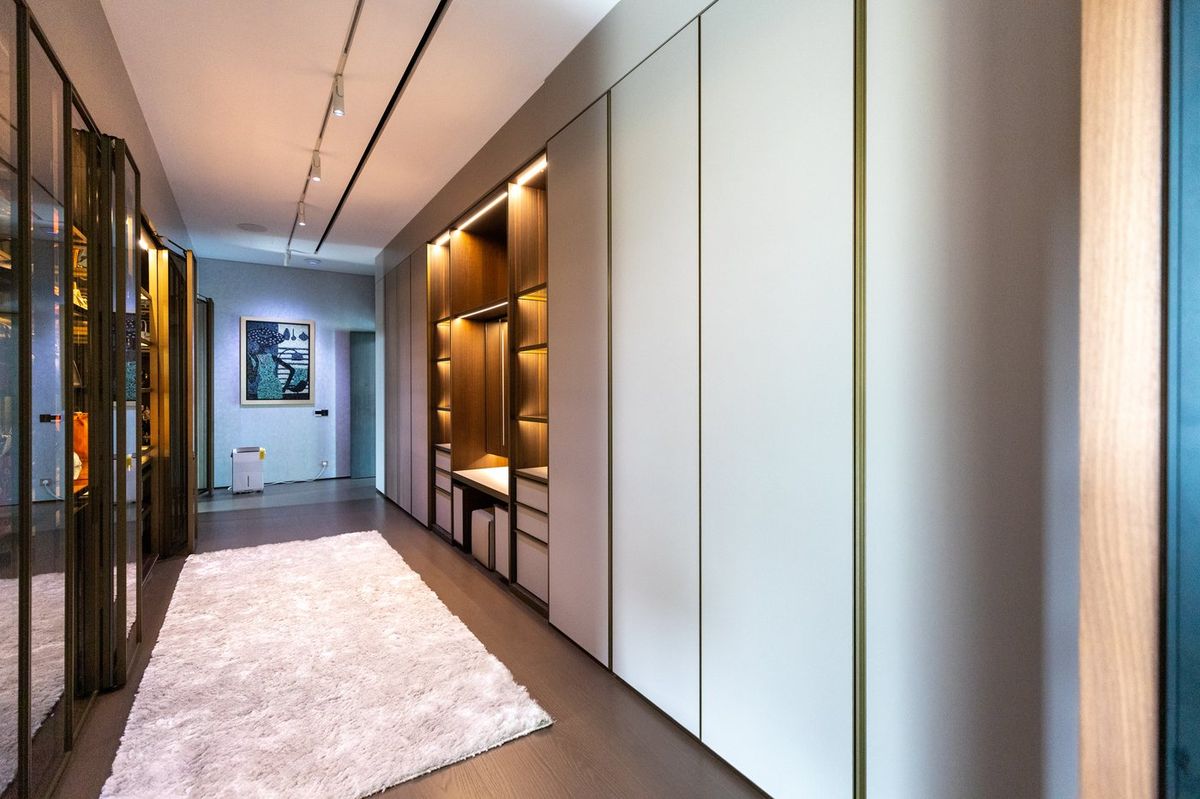
Stages 1 to 3: Measurement, Approval, Production
Almost every dimensional problem that appears at installation was created here. Furniture is manufactured to the dimensions somebody supplied, at a moment when the building may still have been changing.
What decides whether stage 1 to 3 goes well:
- Who measured, and against what — the built condition or the architect’s drawing
- Whether the measurement was taken before or after finished floor levels were laid
- Whether an installation allowance was designed in as filler and scribe material
- Which drawing revision production actually cut to
- Whether M&E positions were confirmed before manufacture or after
The single most common failure is a measurement taken early, a building that then changed, and nobody re-checking before cutting. Our guides to professional site measurement and dimensional control, datums and hold points cover how that risk is managed.
Stage 4: Packing and Documentation Decide the Speed of Everything After
How a factory packs and labels a shipment has more effect on installation speed than almost anything else in the chain. Furniture packed purely for container efficiency arrives as component types rather than as rooms, and somebody in Singapore then has to rebuild the sets.
What good installation-ready packing looks like:
- A packing list that maps cartons to rooms or item references
- Carton labelling that matches the FF&E schedule, not just a running number
- Hardware packs identified and kept with the units they belong to
- Assembly drawings showing sequence, not only an exploded view
- Fixing details for wall-hung and full-height items
- Finish and component schedules for future replacement
Our guide to installation-ready packing and documentation covers what to ask a factory for before the container is loaded.
Stages 5 and 6: Shipping, Customs and Receiving
A container is not a climate-controlled store. Across a voyage it experiences day and night temperature swings, port storage and, occasionally, internal condensation — so the receiving check is looking for moisture as well as impact.
Furniture is received into a warehouse rather than delivered to a live site, because a container arriving at a building has nowhere to unload, blocks the bay, and forces cartons to be opened in a corridor. Our guides to container unloading and FF&E receiving and warehouse receiving and quality inspection cover what is checked and to what depth.
Stages 7 to 9: Staging, Installation, Handover
Release from the warehouse should follow site readiness rather than shipping dates. A room that is not ready cannot absorb furniture, and furniture delivered early to an unfinished room absorbs dust and damage instead.
Installation itself is assembly, levelling, scribing, fixing and then final alignment — in that order, because adjusting before fixing means every adjustment is undone. Handover closes the chain with inspection, defect close-out and the records that make a warranty usable later. Our guides to room-by-room kitting and staged delivery and final inspection and project handover cover both ends.
Who Owns What
Most imported furniture disputes are not about quality. They are about a task nobody was contracted to do. Agreeing the split in writing before ordering removes almost all of them.
Typically the overseas factory:
- Manufactures to the approved drawing revision
- Supplies hardware, fixings and assembly documentation
- Packs, labels and produces the packing list
- Supplies replacement parts under the agreed warranty terms
Typically the Singapore partner:
- Takes or verifies site measurements against the built condition
- Receives, inspects, reconciles and stores the shipment
- Coordinates delivery, lift access and staging
- Assembles, installs, scribes, adjusts and protects
- Carries out local modification and rectification
- Handles snagging, handover and after-sales attendance
Usually needs explicit agreement — this is where projects go wrong:
- Who takes the site measurement, and who carries the risk if it is wrong
- Who pays for local modification when an item does not fit
- Who owns transit damage, and at which point title passes
- Who supplies stone, and whether it is templated overseas or in Singapore
- Who attends during the defect liability period, and at whose cost
- How replacement parts are ordered, shipped and paid for
Where the Chain Usually Breaks
Three failure points account for most lost time on imported furniture projects.
The three recurring breaks:
- Measurement taken early, building changed, nobody re-checked before production
- Packing done for shipping efficiency, so complete room sets have to be rebuilt in Singapore
- No local capability, so a twenty-millimetre problem becomes an overseas reorder
Each of them is cheap to prevent and expensive to fix. The third is the most damaging, because it converts a same-day carpentry job into a two-month freight cycle while a room stays open.
Responsibilities to Confirm Before Ordering
Before placing an order, settle these in writing with the factory. It takes an hour and prevents most of the arguments that otherwise surface at installation.
Confirm before you order:
- Which party measures the site, and against which drawing revision production will cut
- What installation allowance is built into the items as filler and scribe material
- How items will be packed and labelled, and whether by room or by component type
- What documentation ships with the goods
- Incoterms, and the point at which risk and title pass
- Warranty terms, and how replacement parts are requested and shipped
- Whether stone is supplied by the factory or templated and fabricated in Singapore
- Who attends during the defect liability period
Information Needed Before Quotation
For an initial assessment of the Singapore-side scope, the more of this we have, the more accurate the quotation is — and the fewer assumptions end up in it.
Please provide:
- Furniture and installation drawings
- Packing list and item quantity schedule
- Hardware and connector information
- Expected shipment and delivery dates
- Project address, building type and access constraints
- Site photographs of the areas involved
- Project programme, and the date the rooms are needed
Send drawings, packing list, site photographs and project programme to [email protected] for an itemised quotation.
Related Reading by Stage
If you already have a shipment on the way and want the Singapore-side detail, see China furniture installation in Singapore. If you are the manufacturer rather than the buyer, see why overseas manufacturers need a Singapore installation partner. For commercial and hospitality projects specifically, see FF&E receiving, logistics and installation for commercial projects.
Frequently Asked Questions
How long does the whole chain take?
Production and shipping dominate the calendar, but the Singapore-side stages are what usually decide whether the room opens on time. Receiving, staging and installation should be planned backwards from the date the room is needed, not forwards from the container’s arrival.
Should stone be ordered with the furniture or fabricated here?
In most cases, templated and fabricated in Singapore after the base cabinetry is installed and levelled. Stone cut overseas to a drawing frequently does not fit, and unlike timber it cannot be trimmed to suit on site.
Who should take the site measurement?
Whoever carries the risk if it is wrong — and that should be stated explicitly. The measurement also has to be tied to a drawing revision, so production cuts to a known reference rather than to whichever version reached the factory last.
What is an installation allowance?
Filler and scribe material deliberately designed into the items so real wall and floor deviation can be absorbed on site. Without it, a run that is dimensionally correct still cannot be fitted to a wall that bows.
Can furniture be delivered straight from the port to site?
It can, and on small residential jobs it sometimes is. On anything larger it causes more problems than it saves — no space to inspect, no way to reject damage, and cartons opened in corridors.
What happens if something arrives damaged?
Damage found and photographed at the warehouse is a recoverable claim and can be replaced or repaired while other work continues. Damage discovered in a finished room usually is not, which is the entire argument for receiving inspection.
Do you deal with the factory directly?
On many projects, yes — on drawings, packing queries and replacement parts. It shortens the loop considerably compared with every message passing through the client.
What if we have not ordered yet?
That is the best time to talk. Measurement responsibility, packing format, documentation and the split of local work are far cheaper to agree before production than to renegotiate after a container has landed.
More in FF&E Installation
 Rectifying FF&E in a Hotel That Has Already Opened: Room Nights, Housekeeping Access and the Remove-and-Return Cycle
 How Many Spares Should an Imported FF&E Package Carry? A Risk-Based Alternative to the 2% Line
 Large Residential Development FF&E in Singapore: Unit-by-Unit Handover, Defect Patterns and a Liability Period in Occupied Homes