Our acoustic panels are available with independent TÜV test documentation for specified products, helping designers, contractors and facility teams review sound-absorption performance before installation.
Related service: operable walls and acoustic partitions in Singapore.
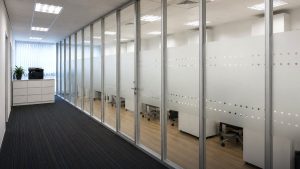
Glass partitions, stone finishes and minimalist furniture can make a modern office look sharp, but extensive hard surfaces may also reflect sound and create unwanted echo. If speech is difficult to understand or video calls sound hollow, acoustic panels can help reduce internal reflections and improve clarity. Acoustic panels do not replace a properly designed sound-insulating wall, door or glazing system.
Understanding Reverberation Time (RT60)
Acousticians use RT60 to describe how long sound remains in a room after the source stops. In rooms with extensive glass, stone or other reflective finishes, repeated reflections can cause words to overlap. Acoustic panels help shorten reverberation and improve speech clarity. For many meeting rooms, approximately 0.5–0.7 seconds may be used as an early design reference, but the appropriate target depends on room size, finishes, occupancy and use.
Four Benefits of Acoustic Panels
1. Clearer speech
Hard walls, glazing and meeting tables reflect sound back into the room. Acoustic panels absorb part of this reflected energy, helping reduce echo and making conversations easier to understand.
2. Better video-call audio
Reflections from hard surfaces can reach conferencing microphones shortly after the direct voice signal, creating hollow or unclear audio. Treating appropriate wall and ceiling areas can provide a cleaner signal for remote participants.
3. Less listening fatigue
Highly reverberant rooms can make conversations tiring to follow and may encourage people to speak more loudly. Suitable acoustic treatment can create a calmer and more comfortable meeting environment.
4. Supports speech privacy
Acoustic panels reduce reflected sound inside a room, but they do not prevent sound from passing through walls or doors. Confidential rooms may also require properly specified partitions, glazing, acoustic doors, perimeter seals and controlled service openings.
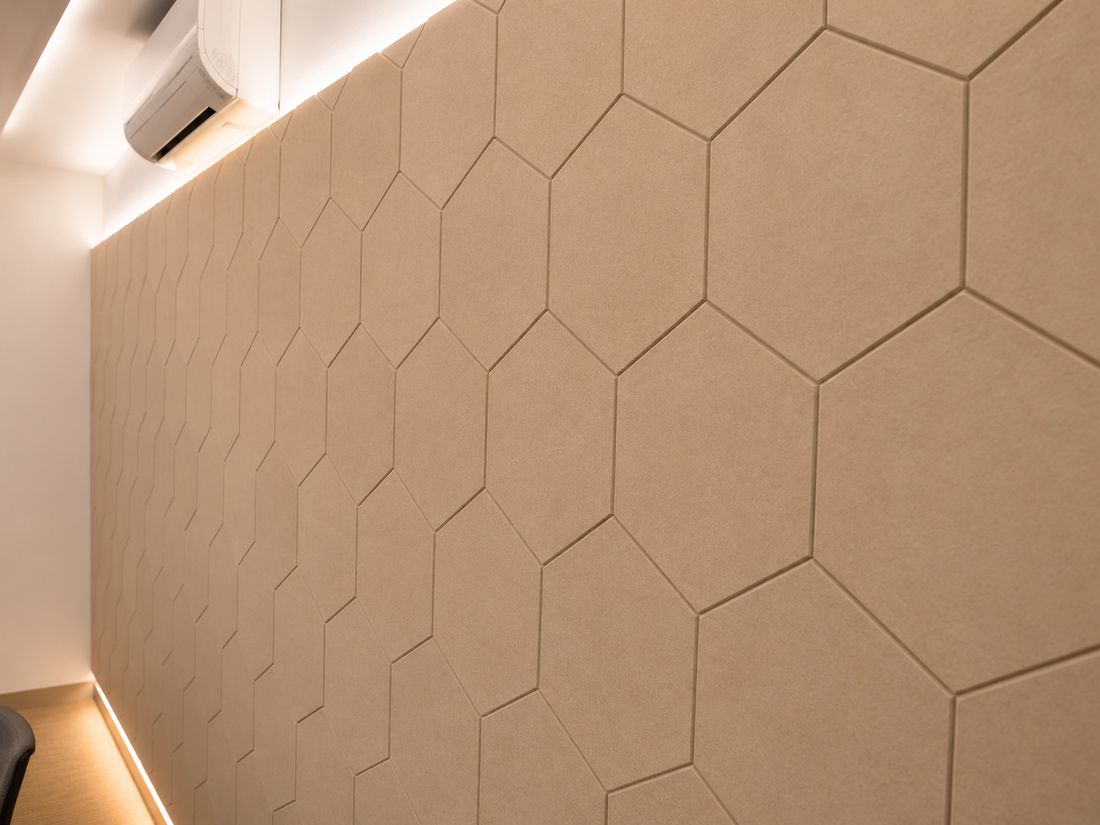
Why Use Hexagonal Acoustic Panels?
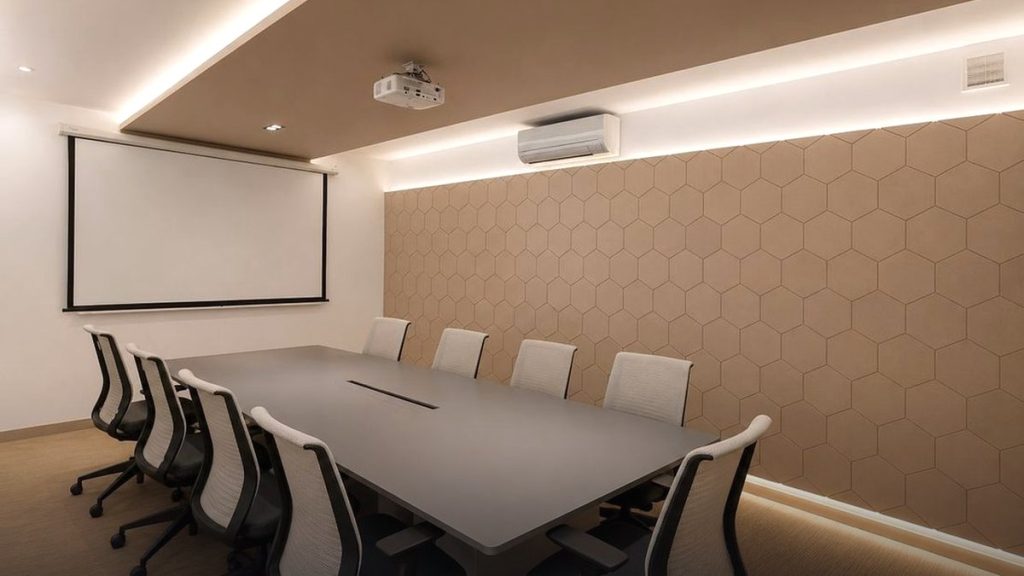
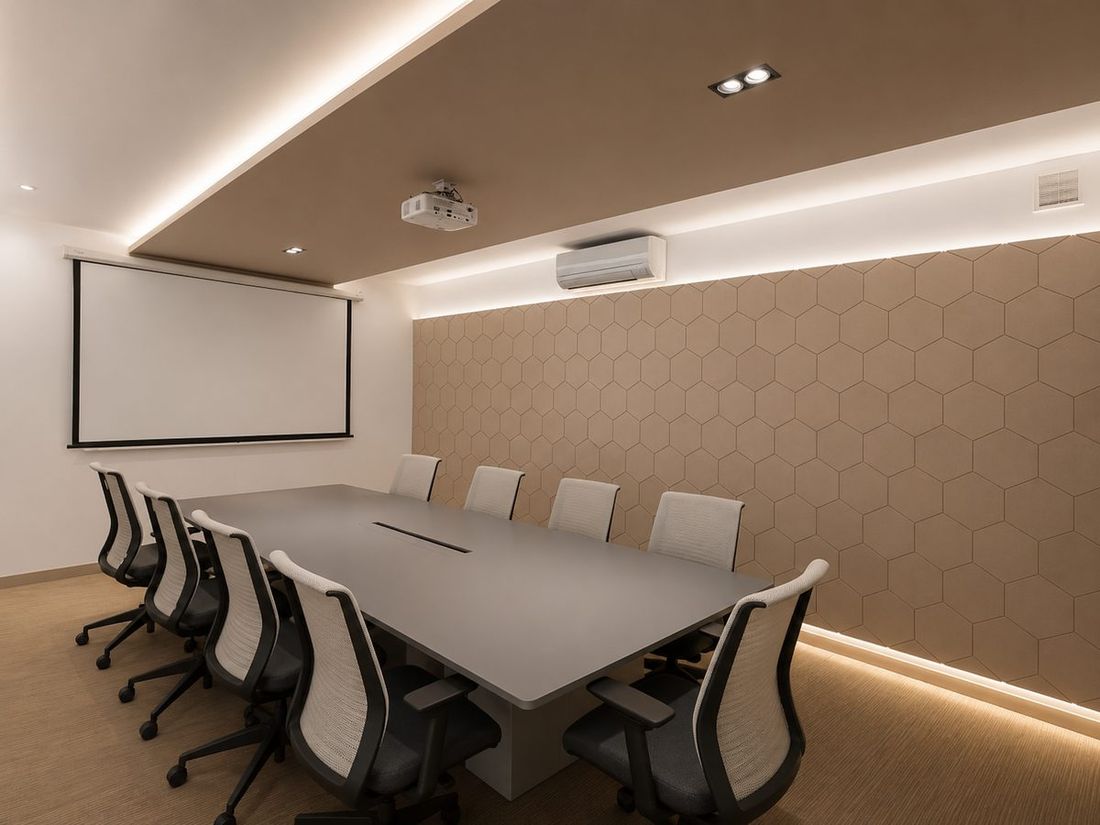
Panel shape is generally less important than material, thickness, mounting method and total coverage. A hexagonal panel and a square panel made from the same material may provide similar acoustic performance.
The main advantage of hexagonal panels is visual flexibility. They can be arranged into continuous geometric layouts, colour patterns or feature walls that integrate acoustic treatment into the interior design.
How Much Treatment Is Needed?
More panelling is not automatically better. The appropriate amount depends on the room dimensions, finishes, furniture, occupancy and the tested performance of the selected product. Preliminary percentages may be useful for budgeting, but the final treatment area should be based on the actual room conditions.
Consider the ceiling
The ceiling is often one of the largest uninterrupted reflective surfaces in a meeting room. Where suitable, acoustic rafts, ceiling clouds or direct-fixed panels above the meeting table can provide effective treatment without occupying wall space.
Treat important wall reflections
Wall-mounted panels are often positioned near major reflection areas, including surfaces around meeting participants, displays and conferencing equipment. The best location depends on the room layout, seating arrangement and microphone position.
What “TÜV-Tested” Means
TÜV reports are issued by independent technical testing organisations. A report records the performance of a specific product tested under defined standards and conditions.
Test results apply only to the product model, material, thickness and installation configuration stated in the report. A report for one panel should not automatically be applied to every product in a supplier’s range.
Depending on the product and report scope, documentation may cover:
- Sound absorption — tested performance across specified frequencies.
- Reaction to fire — where included in the relevant report or classification.
- Material or emissions information — where separately tested and documented.
Each claim should be checked against the documentation supplied for the selected product.
We provide the available documentation for the proposed product with our quotation so that designers, consultants and facility teams can review the applicable test standard, product configuration and reported performance before approval and ordering.
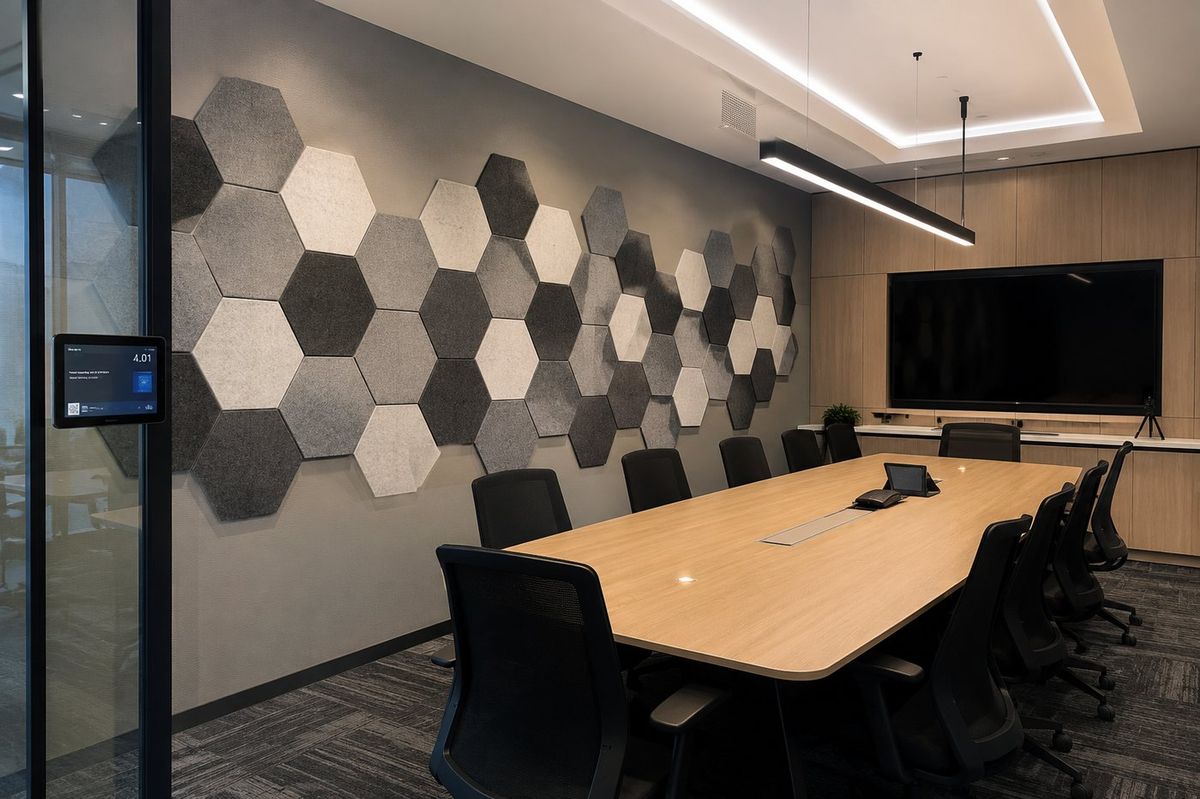
Choosing the Right Panel
Acoustic panels are available in different materials, colours and finishes. The appropriate choice depends on the room’s acoustic needs, design concept, fire requirements, maintenance needs and budget.
- PET polyester felt — available in various colours and modular formats for meeting rooms and office fit-outs.
- Timber-faced acoustic panels — suitable for boardrooms, executive offices and hospitality-style interiors, subject to the tested panel construction.
- Custom layouts — panels can be arranged in geometric, colour-block or branded designs while maintaining the required treatment area.
Frequently Asked Questions
How many acoustic panels does a room need?
The quantity depends on the room’s dimensions, finishes, furniture, occupancy and the tested performance of the selected panel. A glass-walled room with hard flooring will usually require more treatment than a carpeted room with soft furniture.
Will acoustic panels soundproof the room?
No. Acoustic panels reduce echo inside a room. Soundproofing requires an appropriately designed wall, door, glazing and sealing system.
Are hexagonal panels better than flat panels?
Not necessarily. Material, thickness, mounting method and coverage have more influence on acoustic performance. Hexagonal panels are mainly selected for their visual appearance and layout flexibility.
Are the panels fire-rated and safe indoors?
This depends on the selected product. The relevant documentation should be reviewed to confirm whether it covers reaction to fire, emissions, material safety or other required criteria. A report for one product or configuration should not automatically be applied to another.
Send your floor plan, room dimensions and site photographs to [email protected] for an itemised quotation, or visit www.rongdacontractor.com.