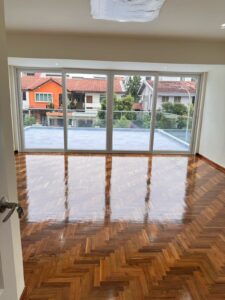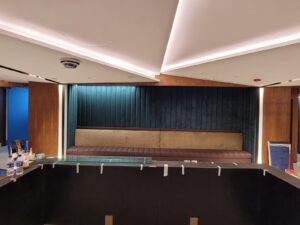
A container clears Keppel on a Tuesday and the furniture inside it is, by every measure the factory can apply, finished. It was cut to an approved revision, assembled, finished, inspected and packed. And it is still perhaps three weeks and a dozen unresolved questions away from being a room anyone can hand over. Everything in that gap happens in Singapore, and almost none of it is manufacturing.
Overseas factories and overseas contractors have become very good at the first half of this. Production capacity, CNC capability, engineering departments, spray lines and export packing are no longer the constraint on a Singapore project. What is left exposed is the second half — the part that takes place on a live site, between other trades, against a main contractor’s programme, under a consultant’s inspection, and then for a year afterwards during the defects liability period.
That second half is what we call the local execution layer. This article sets out what it actually contains, who needs which parts of it, and where the responsibility line between a factory and a Singapore team should sit. It is the overview; the individual capabilities each have their own guide, linked as we go.

Manufacturing Completion Is Not Project Completion
The most expensive assumption in overseas supply is that risk passes when the container is sealed. In practice the container is roughly the midpoint. A cabinet built precisely to drawing can still fail to install because the wall it meets is out of plumb by eleven millimetres, because the finished floor level moved after the measurement was taken, because a sprinkler drop was relocated during construction, or because the room is still occupied by a ceiling contractor who is four days behind.
None of those are manufacturing defects. They are execution problems, and they have a characteristic that manufacturing defects do not: they cannot be solved from another country. Somebody has to stand in the room, measure the actual condition, decide what is acceptable, and either fix it that day or explain precisely what the factory must change.
What the Layer Actually Contains
Stripped of terminology, the local execution layer is seven capabilities. Most overseas suppliers have access to one of them — installation labour — and assume that is the whole scope.
What sits inside each of the seven:
- Site verification – measurement against the built condition, datum and hold-point control, feedback to the factory before cutting
- Receiving and storage – container de-stuffing, quantity and condition inspection, hardware reconciliation, conditioned storage
- Staged delivery – room-by-room kitting, release against site readiness, lift booking and access planning
- Installation – assembly, levelling, scribing, fixing, final alignment, and interface with every adjoining trade
- Local modification – trimming, filler adjustment, cut-outs, hardware repositioning, locally fabricated replacement components
- Finish rectification – colour matching, touch-up, panel refinishing and full-panel respray in a local spray facility
- Handover and DLP – snagging, protection, asset records, defect close-out and attendance for the full liability period
Each of those has a guide of its own: site measurement, warehouse receiving and inspection, kitting and staged delivery, on-site modification, spray-finish rectification and final inspection and handover. What follows is why they belong together rather than being bought separately.
The Capabilities Are Worth More Combined Than Apart
A supplier can, in principle, engage an installer, a mover, a storage provider, a carpenter and a spray shop separately. Projects that do this tend to discover the same thing: the interfaces between those five parties become the project’s largest source of delay, because no single party owns the outcome.
A concrete example. A wardrobe run is found, at installation, to be nine millimetres too long for its recess. If the installer, the carpenter and the finisher are three different companies, that becomes a three-way conversation about who cuts, who re-edges, who touches up the cut edge and who is liable if the finish does not match. Under one scope it is a morning’s work and a single photograph back to the factory. The technical problem is identical; the commercial and programme outcomes are not.
Installation Is an Interface Problem
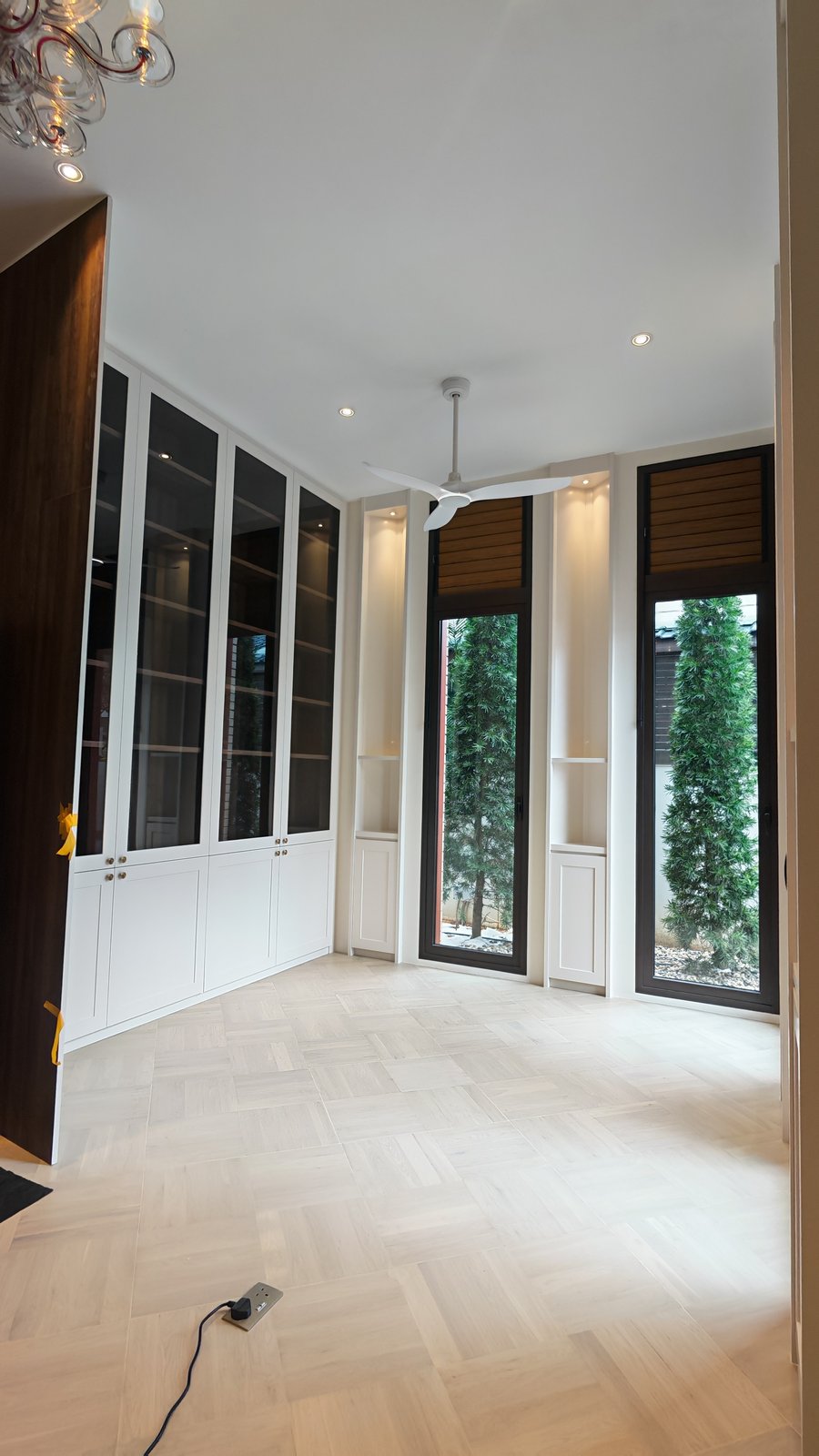
Furniture installation is often priced as though it were an isolated activity, which is why it is often the activity that slips. On a live site, a vanity cannot be set without the plumbing rough-in being final; a kitchen run needs confirmed appliance openings, worktop templating and backsplash levels; a feature cabinet has to clear switches, isolators and access panels that were not on the FF&E drawing; full-height joinery has to reconcile with a ceiling that another contractor has already closed.
This is why we treat coordination as part of the installation scope rather than as something the main contractor does around us. Our guide to interface coordination between furniture and the other trades covers the specific conflicts that recur, and FF&E receiving, logistics and installation for commercial projects covers how the sequence is planned on larger packages.
Local Capability Is What Keeps a Problem Small
The single largest cost difference between a supplier with a Singapore capability and one without is not the installation rate. It is what happens the first time something does not fit. Without local capability, every discrepancy escalates to the only remedy available — a replacement manufactured and shipped from the factory — and a twenty-millimetre problem acquires a two-month lead time while a room stays open.
With local capability, the same discrepancy is triaged. Most are absorbed within the designed allowance or modified on site the same day; a smaller number are refabricated locally in days; only a genuine minority actually need the factory. We set out the full cost comparison in our guide to why overseas manufacturers need a Singapore installation partner, and what can realistically be resolved here in replacement parts and local rectification.
Spray Finishes Are Where Most Suppliers Are Exposed
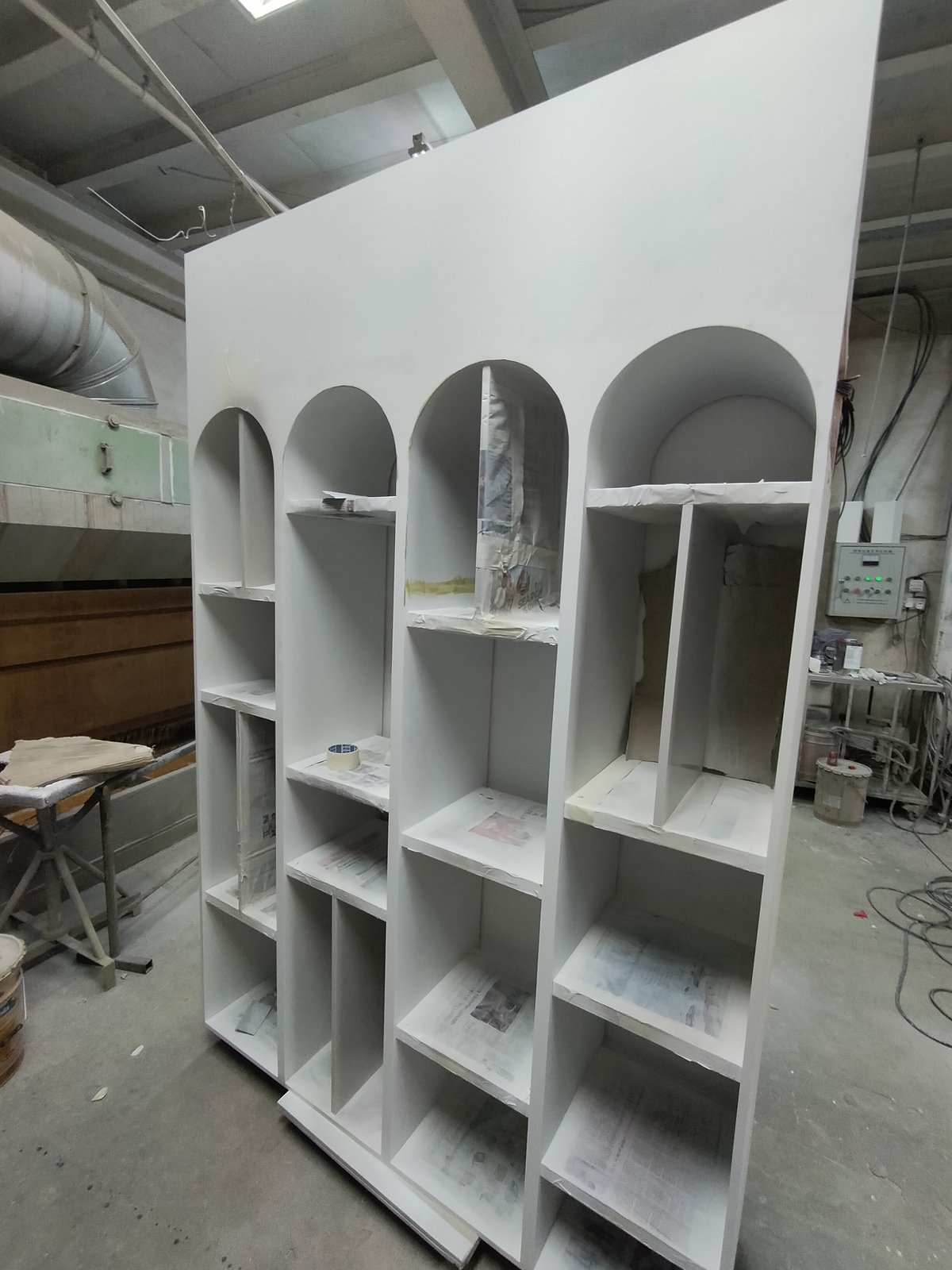
Painted and lacquered components deserve separate mention because they are the category most likely to arrive correct and become defective afterwards. Transit, unpacking, handling, installation and the trades working around a finished room all produce scratches, edge damage, impact marks and contamination — and unlike a chipped carcass, a damaged lacquer face cannot be quietly made good with filler.
Rongda operates its own spray facility and spray team in Singapore, which means colour assessment, matching, preparation, local touch-up, panel refinishing and full-panel respray are available as a local option rather than as a reorder. The technical detail — when to respray rather than touch up, why preparation determines the result, and when the original factory is still the correct answer — is covered in our guide to spray-paint rectification during installation and DLP.
Almost Every Imported Package Sits on Builder’s Works
Imported joinery rarely lands on a site that is ready to receive it without intervention. Wall reinforcement for a cantilevered run, a plinth, a local steel support, an opening formed or closed, a penetration reinstated, making good where the previous condition was demolished — this work is neither furniture nor main-contractor scope in any obvious way, and it is the work most often discovered late.
It also happens to be work Rongda already does in its own right. Our guide to builder’s works for furniture installation covers the mechanics, and the wider fit-out, A&A, hoarding, making good and structural steel scope is set out separately for overseas contractors who need more than a furniture team. Where the works alter the building itself rather than only its contents they cross into a different regulatory regime, and our guide to what counts as A&A works in Singapore sets out where that line sits and what crossing it changes.
The Liability Period Is Part of the Scope
An overseas supplier’s project team goes home shortly after handover. The developer’s obligation does not end there — it runs for the whole defects liability period, and during that period somebody has to attend, inspect, classify, rectify and close each item. Flying a factory team in for a misaligned door is not a plan, and shipping a replacement panel for every scratch is not one either.
This is the part most often left out of a supply agreement and most often argued about afterwards. Our guides to after-sales and defect liability and warranty and after-sales support cover how the arrangement is normally structured.
Where the Responsibility Line Should Sit
Most disputes between a factory and a Singapore site are not about quality. They are about a task nobody was contracted to do. Writing the split down before the first order removes almost all of them.
The overseas factory keeps:
- Manufacture to the approved drawing revision
- Hardware, fixings and assembly documentation
- Packing, labelling and the packing list
- Replacement parts under the agreed warranty terms
- Proprietary finishes and materials that cannot be matched locally
The Singapore execution partner carries:
- Site verification and feedback before production
- Receiving, inspection, reconciliation and storage
- Delivery, access, installation and trade interface
- Local modification, refabrication and finish rectification
- Builder’s works and making good associated with the package
- Snagging, protection, handover and DLP attendance
Agree these explicitly – this is where projects go wrong:
- Who measures the site, and who carries the risk if the measurement is wrong
- Who pays for local modification when an item does not fit
- Transit damage liability and the point at which risk passes
- Whether stone is supplied by the factory or templated and fabricated in Singapore
- How replacement parts are raised, produced, shipped and paid for
- Who attends during the defects liability period, and at whose cost
The same split from the buyer’s side, stage by stage, is set out in our guide to the complete factory-to-Singapore workflow, which is usually the more useful document to share with a client.
When the Layer Should Be Appointed
The common pattern is to look for an installer once the containers are already on the water. By that point the packing format is fixed, the labelling convention is fixed, the production dimensions are fixed, and several avoidable problems are already in the shipment.

Who This Model Is For
The layer is bought by four different parties for four different reasons, and the scope differs accordingly.
Typical arrangements:
- Overseas manufacturers – appoint us directly and include Singapore execution in their offer to the client
- Overseas interior contractors – use us as a local extension of their own project team rather than building a permanent Singapore presence
- Developers procuring direct from China – retain us separately so the execution scope is contracted rather than assumed
- Main contractors – engage us to bring an imported furniture package under the same site discipline as every other trade
For a hotel, serviced apartment or large residential development the scope is heavier still, because volume changes the nature of the problem. Our guides to hotel FF&E installation and hotel FF&E sequencing cover the hospitality case.
How Rongda Pacific Works as the Execution Layer
Rongda Pacific Pte Ltd is a Singapore contractor, not an agent. We install to the manufacturer’s drawings, specifications and intended finish, and where the built condition forces a deviation we document it with measurements and photographs and send it back rather than improvising quietly. Alongside furniture and joinery we carry out commercial fit-out, A&A works, builder’s works, hoarding, making good, structural steel support and M&E-related coordination, which is why an imported package rarely has to be handed between contractors on our projects.
The feedback loop is the part manufacturers tend to value most. A recurring fitment issue that would otherwise repeat across five projects gets corrected after the first, because somebody in Singapore measured it and explained why.
Frequently Asked Questions
What is a local execution partner, as distinct from an installer?
An installer supplies labour to assemble and fix furniture. An execution partner carries the whole Singapore-side scope – site verification, receiving, staged delivery, installation, trade interface, local modification, finish rectification, builder’s works, handover and DLP attendance – and is accountable for the room rather than for the furniture.
We already have a Singapore client. Why do we need a partner as well?
Because your client is buying furniture, not installation capability. If the site team has no experience of imported cabinetry, cam-lock assembly or scribing, the finished room reflects on your factory regardless of how well the panels were made.
Do you work for the factory or for the end client?
Either. Some manufacturers appoint us directly and include installation in their offer; on other projects the developer or main contractor engages us and we coordinate with the factory. What matters is that the responsibility split is written down before the first container.
Will you follow our drawings and assembly sequence?
Yes. We install to the manufacturer’s drawings, specifications and intended finish. Where the built condition forces a deviation it is documented with photographs and measurements and sent back, not improvised.
Can spray-finished panels really be rectified locally?
Many can. We operate our own spray facility and spray team in Singapore, covering colour matching, preparation, local touch-up, panel refinishing and full-panel respray. Whether local repair is the right answer is a technical judgement made item by item – some defects should still go back to the factory.
Does the scope have to include everything?
No. Some suppliers need installation only. The layer is modular, and most projects start with installation and add receiving, modification or DLP attendance once the value becomes obvious.
Can you handle work that is not furniture?
Yes. Builder’s works, making good, hoarding, structural steel support, M&E-related coordination, commercial fit-out and A&A works are part of our own business, which is usually what an overseas contractor is missing rather than carpentry.
When is the best time to appoint you?
Before production, if the project allows it. Site verification, packing format and delivery planning are all far cheaper to influence before cutting starts than to correct after a container has landed.